
Dating Anxiety is Real. What If It Leads to Unplanned Pregnancy?
Medically Reviewed By: Dr. Devi (MBBS, MD)
Contents of This Post:
- What Sexual FOMO Actually Feels Like?
- Firstly, Dating Apps Laid the Foundation Stone for Turning Romance Into a Numbers Game
- Secondly, Social Media Enters. Yet, it Doesn’t Show You Reality
- Next, Cultural Messaging Adds Fuel to the Fire
- When You’re Single: “Am I Falling Behind?”
- When You’re Married: “Did I Miss My Chance?”
- The Real Problem: FOMO Doesn’t Stay in Your Head
- You May Not Know the Risks Beneath the Iceberg’s Tip: Let’s Discuss Real Health Issues
- So, What Can You Actually Do About It?
- You’re Allowed to Opt Out of the Comparison
- American Hospital Bangalore Stands With You for Safe, Legal, Confidential Abortion Care, Without Judgment
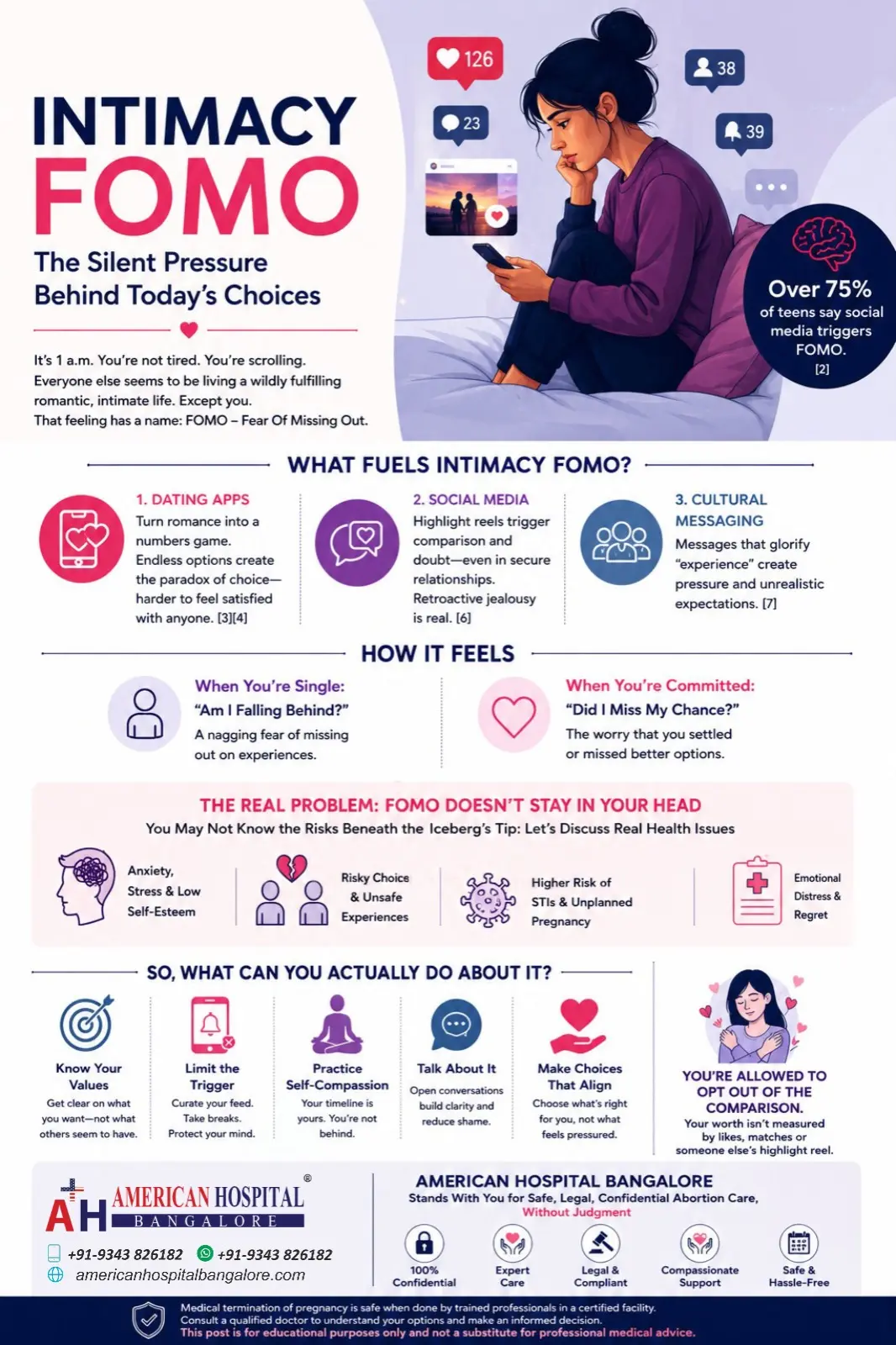
It’s 1 a.m. You’re not tired. So, you’re scrolling.
Someone from college just posted a couple’s selfie captioned “finally found the one.” Someone else shared a vague, glowing story about a date that “changed everything.” Also, your dating app shows three new matches, and you haven’t even opened the last five.
Somewhere in your chest, a familiar feeling shows up. Everyone else seems to be living some wildly fulfilling romantic, sexual life. Except you.
Maybe you put the phone down for a second. Or maybe you just keep scrolling anyway, chasing whatever it is you think you’re about to find.
That feeling has a name. It’s FOMO, short for fear of missing out. It used to be about parties and vacations you weren’t invited to. Now, it’s crept into our bedrooms, our DMs, and honestly, our sense of self-worth.
So, let’s talk about it, because this feeling is doing more damage than most of us realise.
What Sexual FOMO Actually Feels Like?
Psychologists mapped out FOMO over a decade ago. They described it as the anxious sense that other people are out there having rewarding experiences, and you’re not part of them [1]. But, back then, most of the research focused on missed parties and group hangouts.
Today, that same anxiety has a sexual, romantic dimension too. It sounds like: Am I having enough experiences? Am I with the right person? Did I already miss my window?
Besides, for some people, it attaches itself to a number: how many partners, how many years together, how many “firsts” already checked off. And for others, it’s vaguer than that, just a nagging sense of standing outside something everyone else seems to have already figured out.
Additionally, it rarely announces itself loudly. Usually, it’s just a small ache after you close an app.
And it’s incredibly common. Recent survey data shows over three-quarters of teens say social media specifically triggers this feeling, and most young adults report experiencing some version of it weekly [2]. However, this isn’t a personal flaw or a sign you’re insecure. Rather, it’s a predictable reaction to living a life that’s spent partly on a screen.
Firstly, Dating Apps are Responsible for Turning Romance Into a Numbers Game
Now, here’s where it gets interesting. Dating apps didn’t invent insecurity about our love lives. But they gave it an interface.
India’s online dating market is now worth close to 800 million dollars. Additionally, industry researchers expect it to grow past 1.4 billion within the next several years, making it one of the fastest-growing dating markets in the world [3]. Also, a huge share of that growth comes from users under 35, with Gen Z driving most of the daily activity in cities like Bangalore, Delhi, and Mumbai.
Now, every swipe promises something new. And every match feels like tiny proof that you’re desirable. But this constant stream of “options” plays tricks on the brain. When there’s always someone new to swipe on, sitting still, even in a genuinely good relationship, can start to feel like settling. So, even choosing not to date at all can feel like falling behind some invisible schedule everyone else is apparently keeping.
This is sometimes called the paradox of choice. Furthermore, the more options you’re shown, the harder it becomes to feel satisfied with any one of them, even a genuinely good one. Your brain didn’t evolve to sort through hundreds of strangers a week. Rather, it evolved to bond slowly, with a handful of real people, over time. But an app built entirely around endless options asks it to do the opposite.
Now, here’s the twist, though.
Most people aren’t even using these apps just for hookups. More than half of Gen Z users say they’re actually looking for something serious. So, while people love to blame dating apps for turning romance into a game, most of us are quietly hoping for real connection underneath all that swiping.
That gap, between what we’re hoping for and what app culture seems to promise everyone else, is exactly where FOMO grows.
Secondly, Social Media Enters. Yet, It Doesn’t Show You Reality
Dating apps aren’t the only culprit. Social media plays its own part, and arguably a bigger one.
Researchers who study jealousy in relationships found something surprising. People don’t need an actual threat to feel unsettled. Simply scrolling through a partner’s old photos, or a stranger’s highlight reel, can trigger comparison and doubt, even in completely secure relationships. Psychologists call this retroactive jealousy. Social platforms make it worse because they hand you someone’s entire romantic history in one scroll, any time you want it.
And this isn’t an accident. Platforms are built to keep you scrolling, and content that provokes a strong reaction- jealousy, envy, longing- tends to perform well. So, that means the posts most likely to trigger your sexual FOMO are also the ones an algorithm is most likely to keep putting in front of you.
Now, the same comparison mechanism shows up when you’re single. Every soft launch, every couple’s vacation photo, every flirty comment thread quietly asks the same question: why isn’t my life like this?
Here’s the thing, though. What you’re seeing isn’t real life. It’s a highlight reel, curated and filtered before it ever reaches your feed. So, comparing your actual, complicated, in-progress life to someone else’s edited version is a losing game, every single time.
Next, Cultural Messaging Adds Fuel to the Fire
Beyond apps and feeds, culture itself sends deeply mixed signals, and this hits differently depending on where you grew up.
Many of us grow up with one set of rules around sex and relationships, often quiet, conservative, family-driven ones, while scrolling through an entirely different set online. On the other hand, pop culture and influencer content glamorise sexual experience as a badge of honour, then turn around and shame people for having “too much” of it. One video preaches sex positivity. But the next spreads not-so-subtle judgment about virginity, or the lack of it.
For many young women, especially in India, this creates a strange double bind. Family and community may still expect conversations about relationships to wait for “the right time,” usually somewhere around marriage. Meanwhile, peer culture and social media suggest that everyone your age is already sexually experienced, adventurous, and completely unbothered by any of it. So, you end up feeling judged no matter which way you lean, so plenty of people quietly split the difference: one version of themselves at home, a different one online.
Now, this contradiction leaves almost no room to feel like you’re doing it “right.” Whatever choice you actually make, someone, somewhere, will insist it’s the wrong one.
When You’re Single: “Am I Falling Behind?”
If you’re unmarried, this anxiety often takes a very specific shape. You start wondering whether your sexual experience, or the lack of it, says something about your worth. Your friends casually mention partners you’ve never had, and you nod along, quietly panicking. Or maybe you’ve never had sex at all, and it feels like a secret you have to manage rather than just a fact about your life. So, you scroll past a friend’s engagement post and, before you can stop yourself, start doing the math: how many people did she date before this, and how many have I?
Now, here’s something that might genuinely surprise you, though. Despite how loud hookup culture looks online, actual behaviour tells a very different story.
Recent data shows roughly a quarter of Gen Z women, and closer to a third of Gen Z men, haven’t had partnered sex in the past year. That’s roughly double the rate seen among millennials at the same age. Weekly sexual activity has dropped too. Only about 37% of adults reported having sex every week in 2024, compared to 55% back in 1990.
In other words, the loudest voices online don’t represent what’s actually happening in most people’s lives. So, you’re very likely not as “behind” as it feels sitting alone with your phone at night. Also, most people are just as unsure, awkward, and inexperienced as you are. They’re simply better at hiding it behind a confident caption.
When You’re Married: “Did I Miss My Chance?”
FOMO doesn’t disappear once you’re in a relationship or married. If anything, it just changes shape.
Long-term partners sometimes catch themselves wondering what they missed by settling down early. Could I have explored more? What would it have felt like with someone else? An old flame’s profile pops up looking impossibly happy, and suddenly “what if” swallows a whole evening.
Now, this isn’t a sign your relationship is broken. It’s actually a well-documented psychological pattern.
Researchers have found that people generally regret missed opportunities far more than they regret things that simply didn’t work out. In one study, participants were over three times more likely to name a missed romantic chance as their biggest regret, compared to an actual rejection they’d lived through. Separately, researchers studying sexual regret found this “path not taken” feeling shows up differently by gender. Men tend to regret missed sexual opportunities more. While women are more likely to regret casual encounters they did have.
Also, social media adds its own layer of pressure here too. A trending audio about “the one that got away,” or a friend’s post about unexpectedly reconnecting with an ex, can stir up a feeling that has very little to do with how you actually feel about your relationship on an ordinary day. Instead, it says more about what’s constantly being shown to you than about anything actually missing from your life.
So if you’re partnered and occasionally wonder “what if,” you’re not broken, and you’re definitely not alone. It’s a very human quirk of how regret works, not proof that you chose the wrong life.
The Real Problem: FOMO Doesn’t Stay in Your Head
Here’s where this stops being just an emotional issue and starts becoming a health one.
Research consistently links higher FOMO to a stronger pull toward short-term, casual sexual encounters. One study of American adults found that people who scored higher on FOMO reported more frequent fantasies about short-term sex, along with a higher average number of past sexual partners. Researchers described this as a short-term mating orientation: a heightened drive to seek new partners and prove your own desirability through sexual attention, rather than through deeper connection.
Now, there’s a reason why this happens. Psychologists trace FOMO back to a few unmet needs, mainly feeling capable, in control, and genuinely connected to other people [1]. When that sense of connection is missing, sex or sexting can start to feel like a shortcut back to feeling wanted, even when it isn’t actually what your heart is craving for.
Similarly, the online pattern reveals similar result. Now, this part matters. A 2025 study of young adults found that FOMO didn’t predict casual, consensual sexting done for fun, flirting, or self-expression. Rather, it specifically predicted risky sexting: sending sexts under the influence of substances, to strangers, or as a way to cope with loneliness and low self-worth.
Notice the pattern here. FOMO doesn’t just make people want more connection. It also pushes them toward the riskiest, least considered versions of it. So, quick hookups instead of real dates. Similarly, sexting strangers instead of people they trust. Finally, decisions made from a need to feel wanted, rather than genuine desire.
And when you make decisions quickly, from that anxious headspace, protection is usually the first thing you skip.
What’s Actually at Stake?
Now, this is the part nobody talks about enough.
Sexually Transmitted Infections (STIs):
Firstly, sexually transmitted infections (STIs) are already a massive, underreported public health issue. Also, the World Health Organisation (WHO) estimates that more than one million people acquire an STI every single day, worldwide. Chlamydia alone accounts for roughly 129 million new infections a year, and about two-thirds of those cases occur in people aged 15 to 24. Besides, caase numbers are climbing in many regions, not falling.
Furthremore, left untreated, some of these infections carry consequences that outlast the initial diagnosis by years. Pelvic inflammatory disease (PID), chronic pain, and fertility complications down the line are all real possibilities. In addition, many STIs show no obvious symptoms in their early stages. That’s exactly what makes them so easy to pass on without ever realising it.
Unplanned Pregnancies:
Secondly, unintended pregnancy tells a similarly sobering story. Globally, close to half of all pregnancies are unplanned. In India specifically, roughly one in four pregnancies is unplanned, according to national health survey data.
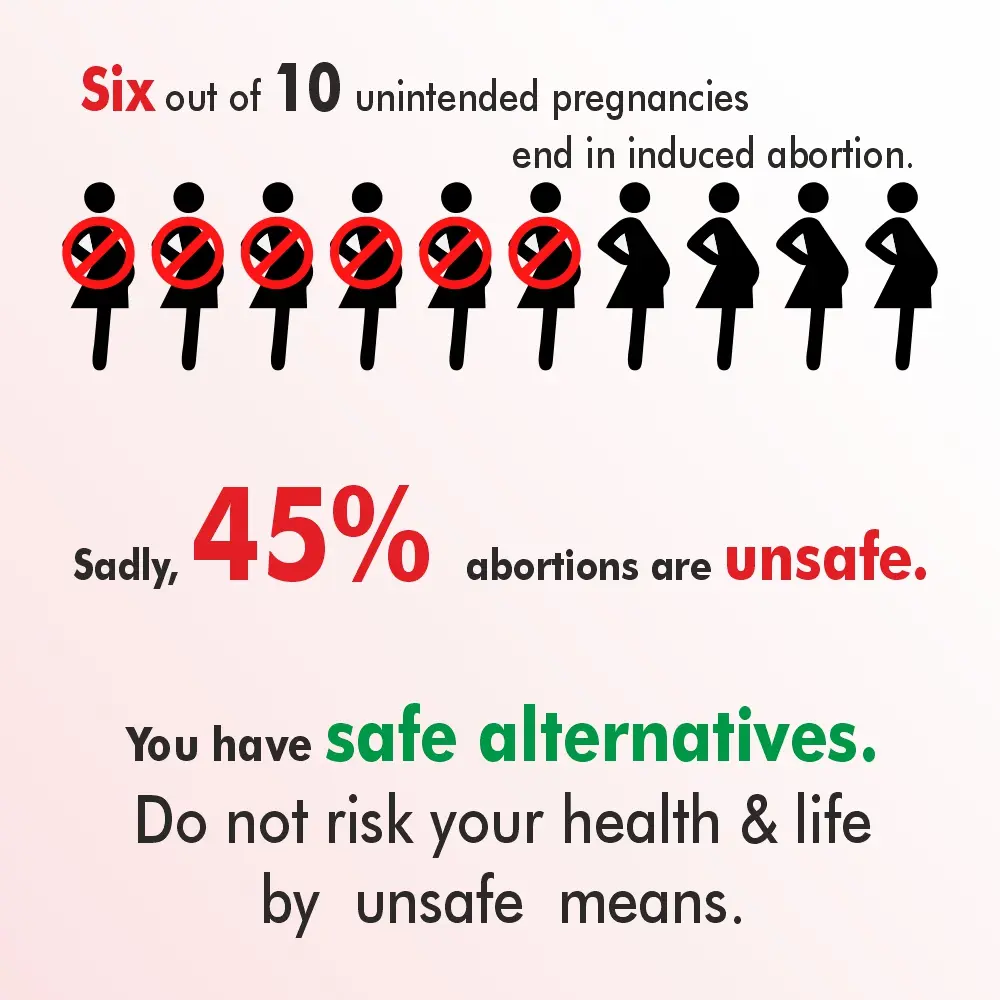
Unintended Pregnancies
Besides the physical risk, there’s an emotional cost too. An unwanted pregnancy scare or an STI diagnosis can bring shame, secrecy, and a spiral of anxiety, especially when anxiety drove the original decision in the first place. It’s a cruel loop. Firstly, FOMO pushes you toward a rushed choice. And then, the fallout from that choice often brings even more fear and isolation than the FOMO did.
None of this should scare you away from intimacy. Sex isn’t the enemy here. But sex driven by anxiety, by a need to prove something to yourself or to an audience you’ll never actually see reacting, tends to skip the basics. Firstly, a conversation about protection. Secondly, a pause to check in with yourself. Finally, consent that’s genuinely considered, not just assumed.
So, What Can You Actually Do About It?
None of this means swearing off dating apps or deleting Instagram, though a break never hurts. Rather, it mostly means building a few honest habits.
Firstly, notice the trigger. If a scroll session leaves you anxious, unsettled, or suddenly making plans you wouldn’t otherwise make, that’s FOMO talking, not desire. Here, naming it in the moment takes away a lot of its power.
Secondly, know your own reasons. Before saying yes to a hookup, a message, or anything else, ask yourself honestly: is this what I actually want, or is this about not wanting to feel left out? Now, the answer changes how good the choice will feel afterwards.
Thirdly, slow down before you act. Decisions made from panic rarely age well. So, a five-minute pause before a hookup, a message, or a sext gives your actual preferences time to catch up with your anxiety.
Next, keep protection non-negotiable. Condoms, contraception, and honest conversations with partners aren’t mood killers. Rather, they’re the difference between a choice you feel good about later and one that costs you far more than a single night.
Next, get tested regularly, even without symptoms. Plenty of infections show no obvious signs early on. So, routine screening is one of the simplest ways to look after both yourself and anyone you’re intimate with.
Finally, talk to someone you trust. A friend, a doctor, even a counsellor can offer perspective that your feed never will.
You’re Allowed to Opt Out of the Comparison
If there’s one thing worth taking from all of this, it’s that your timeline is yours. Nobody else’s swiping, posting, or bragging changes what’s actually right for your body and your life.
So, slowing down isn’t falling behind. Also, choosing a partner carefully isn’t missing out. And if you do find yourself somewhere unexpected- an unwanted pregnancy, a scare, a decision you need real support with- that doesn’t make you careless or broken either.
It makes you human.
We’re Here, Without Judgment: American Hospital Stands With You for the Need of Safe, Legal & Confidential Abortion Care
If a moment of impulsivity, a broken condom, or a contraception failure has left you facing a surprise pregnancy, please know you have options, and you have support.
At American Hospital Bangalore, we offer safe, legal abortion care in a space built on confidentiality and compassion. So, there’s no lecture waiting for you here, no judgment. Just experienced doctors and a team that treats your privacy as non-negotiable.
Whether you live in Bangalore or you’re travelling from elsewhere in India or from abroad, our team walks you through every step, discreetly and with genuine care.
You deserve a healthcare experience that respects your choices as much as it protects your health. That’s exactly what we’re here for.
Sources:
- Przybylski, A. K., Murayama, K., DeHaan, C. R., & Gladwell, V. (2013). Motivational, emotional, and behavioural correlates of fear of missing out. Computers in Human Behaviour, 29(4), 1841–1848.
- FOMO Statistics Report (2025), gitnux.org.
- India Dating Apps Market reports, MarkNtel Advisors (2025) and The Report Cubes (2025).
Related Posts:
- Firsly, Do You Know Your Gut and Your Period Talk to Each Other?
- Secondly, PMOS Doesn’t Mean You Can’t Get Pregnant — And Here’s Why That Matters
- Thirdly, Missed Period in Your 40s, 50s? Is it Perimenopause or Pregnancy?
- Next, How Does a Safe Abortion Protect Your Well-Being? Why hospital choice matters?
- Next, Can Any Woman Choose to Get an Abortion in India?
Quick Links:
- Firstly, Why You Must Know Your Blood Type Before an Abortion?
- Secondly, Will Anyone Know? How to Secure 100% Anonymous, Legal MTP in Bangalore?
- Thirdly, Abortion in India at 8 Weeks Pregnancy: What You Should Know?
- Next, How to Obtain a Safe Abortion in Middle East During Current War Situation
- Finally, Flags Wave for National Freedom, Yet Women Wear a Mask of Silence


Leave a Comment