
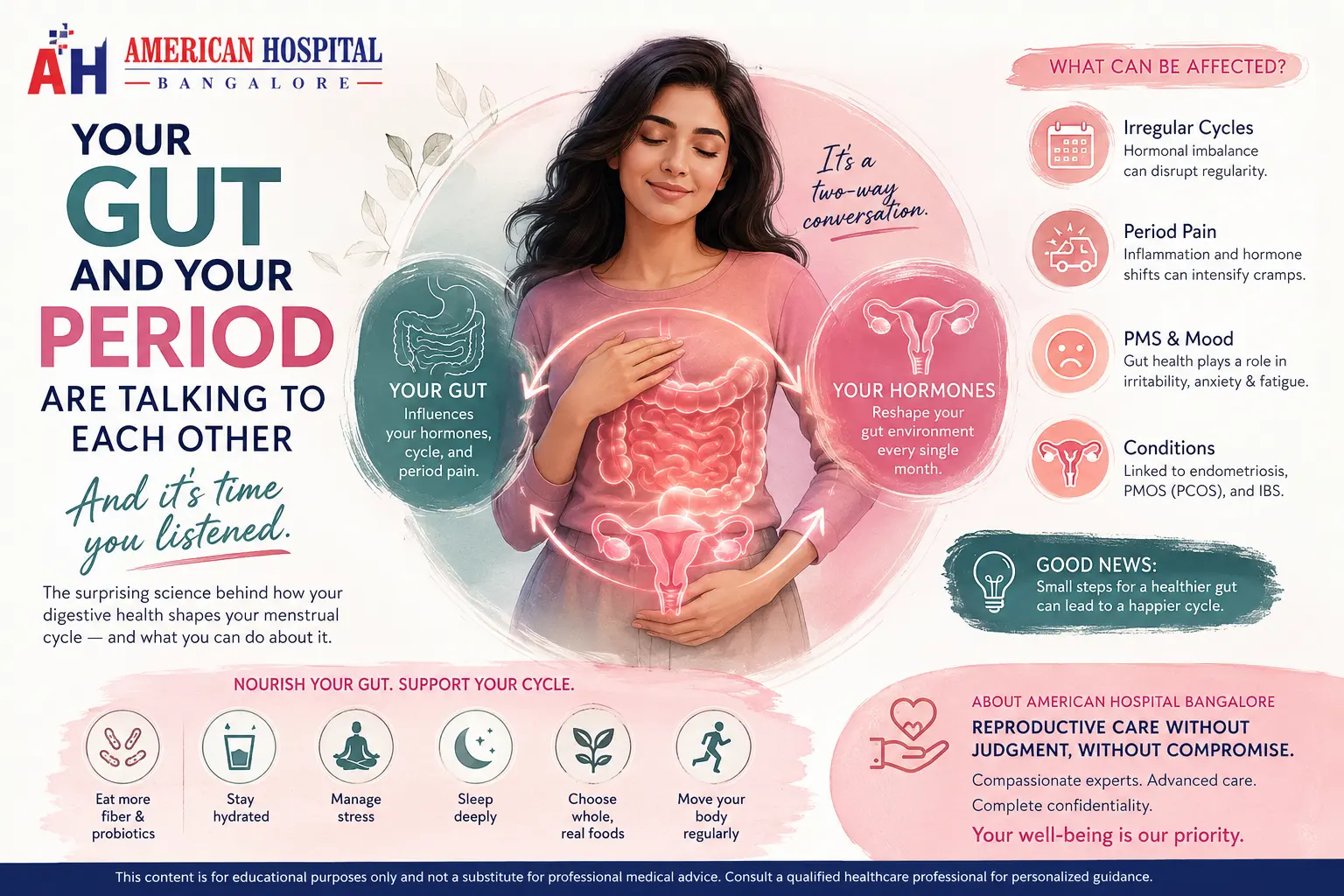
Do You Know Your Gut and Your Period Talk to Each Other?
Medically Reviewed by Dr Devi (MBBS, MD)
American Hospital Bangalore explores the surprising science behind why your digestive health shapes your menstrual cycle — and what you can do about it.
Contents of This Post:
- Meet the Estrobolome — The Gut’s Hidden Hormonal Superpower
- How Your Hormones Change Your Gut — Every Single Month
- The IBS-Period Connection: When the Two Collide
- Gut Dysbiosis and Endometriosis: A Disturbing Link
- PMOS and the Gut: Another Critical Connection
- Warning Signs That Your Gut Is Affecting Your Period
- What You Can Do: Practical Steps to Support Your Gut-Cycle Connection
- About American Hospital Bangalore: Reproductive Care Without Judgment, Without Compromise
Be honest. When your period arrives and your stomach is bloated, cramping, and staging what feels like a full-scale rebellion — do you think of it as a gut problem or a period problem?
Most women choose one or the other. They grab a hot water bottle for the cramps. Or a probiotic or some home remedies like carom seeds or fennel for the bloating. Most women often treat each symptom as though it belongs to a completely separate department of the body.
Here is what the science has been quietly establishing over the past decade: your gut and your uterus are not in separate departments. They are in constant, dynamic conversation with each other. What happens in your digestive system influences your hormones, your cycle regularity, your period pain, your PMS symptoms, and even conditions like endometriosis. And what happens hormonally across your menstrual cycle, in turn, reshapes your gut environment every single month.
This is a two-way street — and understanding it can genuinely change how you care for your body.
So let us slow down and actually listen to that conversation.
Meet the Estrobolome — The Gut’s Hidden Hormonal Superpower
Before we get into the specifics of what goes wrong when your gut is unhappy, let us start with something remarkable. And most women have never heard of it. We speak of the ‘estrobolome’.
Your gut is home to a community, trillions of microorganisms. These include bacteria, fungi, viruses. They are all collectively known as the gut microbiome, a small ecosystem within your gut. Within this community, a specific subset of bacterial genes does something fascinating. It directly manages how your body processes and recycles oestrogen. Scientists have coined a name for this group of genes: the estrobolome.
Here is how it works.
After your liver processes oestrogen and prepares it for excretion, it packages it up and sends it to the gut. Ideally, it exits the body in your stool. Simple enough. But the estrobolome produces an enzyme called beta-glucuronidase, which can essentially unwrap those packaged oestrogen molecules and send them back into circulation through the intestinal wall.
When this recycling happens in appropriate, controlled amounts, it helps maintain healthy oestrogen levels. When it gets disrupted, usually due to an imbalance in the gut microbiome, the consequences ripple outward through your entire hormonal system.
Too much recycling pushes oestrogen levels higher than they should be, fuelling a state called oestrogen dominance. Too little recycling can suppress oestrogen to levels that affect cycle regularity. Either way, an imbalanced estrobolome means imbalanced hormones. Further, imbalanced hormones mean a menstrual cycle that is harder to live with.
The estrobolome is a relatively new area of research, but the evidence is already compelling. A healthy, balanced gut microbiome helps maintain mucosal integrity, prevents the translocation of bacterial content, contributes to immune function, and supports healthy oestrogen metabolism. Conversely, gut dysbiosis — an imbalance in those microbial communities — has been linked to oestrogen-dependent diseases including endometriosis, PMOS (formerly PCOS), and even hormone-sensitive cancers.
In short: the health of your gut is not just about digestion. It is also about hormones. And hormones are everything when it comes to your period.
How Your Hormones Change Your Gut — Every Single Month
The relationship between the gut and the menstrual cycle is two-way. While the gut shapes your hormones through the estrobolome, your hormones — specifically oestrogen and progesterone — also reshape your gut environment throughout the month. Understanding this cycle-within-a-cycle helps explain why your digestive symptoms often follow a predictable monthly pattern.
Here is a rough guide to what happens at each phase.
During menstruation (Days 1–5):
Oestrogen and progesterone are both at their lowest levels. Prostaglandins — hormone-like chemicals that trigger uterine contractions — also stimulate the smooth muscle in your intestines. This is why so many women experience diarrhoea, looser stools, or urgency during the first few days of their period.
Your uterus and your gut are essentially responding to the same chemical signals at the same time. A large study analysing data from over 33,000 menstrual cycles found that women reported gastrointestinal symptoms significantly more frequently in the luteal phase than the follicular phase [1]. Not only this, but the studies also found that mood symptoms have a positive association with gut symptoms in both phases.
During the follicular phase (Days 6–14):
Oestrogen rises steadily. As it does, many women notice their digestion actually feels better — less bloating, more regular bowel movements, and a general improvement in how their gut feels. This is not a coincidence. Rising oestrogen levels tend to improve gut motility and reduce intestinal inflammation.
Around ovulation (Day 14):
A surge in luteinising hormone triggers ovulation. Many women notice mid-cycle spotting or mild cramping, sometimes accompanied by a brief shift in digestion. For those with conditions like IBS or SIBO (Small Intestinal Bacterial Overgrowth), this hormonal peak can occasionally trigger a flare.
During the luteal phase (Days 15–28):
Progesterone rises significantly after ovulation. Progesterone slows the movement of food through the digestive tract. This explains the constipation, bloating, and that uncomfortable sense of fullness being so common in the week before your period. As progesterone and oestrogen both drop sharply toward the end of this phase, PMS symptoms peak alongside digestive discomfort.
The takeaway? The monthly hormonal rhythm you experience is not just about your uterus. It is playing out in your gut simultaneously.
The IBS-Period Connection: When the Two Collide
If you have Irritable Bowel Syndrome (IBS), the gut-period relationship is particularly intense — and particularly difficult.
Do you know more women suffer from IBS (roughly twice) compared to men? And a significant body of research points to sex hormones as a key reason. Cells in the gut carry receptors for both oestrogen and progesterone.This means the digestive system is quite literally designed to sense and respond to these hormones.
The statistics on the overlap between IBS and menstrual symptoms are striking. In studies of over 150 menstruating women with IBS, approximately 45% also experienced dysmenorrhoea (painful periods) and 35% experienced PMS symptoms [2]. Women with IBS reported higher levels of uterine cramping pain during menstruation than women without IBS. And in one study, roughly 40% of women with IBS said their condition directly affects their menstrual cycle symptoms.
Furthermore, more than 50% of women with IBS suffer from abdominal bloating across all phases of the menstrual cycle — not just during their period — which significantly affects their quality of life and daily activities [3].
Around 4.2 to 7.5% of the Indian population suffers from IBS, making this an enormous and largely underdiscussed public health issue. The overlap with menstrual symptoms means that many women are unknowingly managing two interconnected conditions as though they are completely unrelated.
If your gut symptoms reliably worsen in the days before your period and during menstruation, IBS — or at the very least, gut dysbiosis — is worth investigating seriously.
Gut Dysbiosis and Endometriosis: A Disturbing Link
Of all the conditions in which gut health appears to play a role, endometriosis has attracted some of the most significant and urgent research attention in recent years.
Endometriosis is a condition in which tissue similar to the uterine lining grows outside the uterus — on the ovaries, fallopian tubes, or pelvic lining. It affects roughly 10% of women of reproductive age worldwide and is notoriously difficult to diagnose, with an average diagnostic delay of seven to ten years. Chronic pelvic pain, extremely painful periods, pain during intercourse, and infertility are its most common features.
For a long time, endometriosis was understood primarily as a hormonal and immune condition. What researchers have since identified, however, is that the gut microbiome — and specifically the estrobolome — may be deeply implicated in its development and progression.
Endometriosis both promotes and responds to oestrogen imbalance, leading to intestinal bacterial estrobolome dysregulation and a subsequent induction of inflammation. Gut dysbiosis can increase systemic oestrogen levels through enhanced deconjugation and reabsorption, thereby promoting a hyperoestrogenic environment that favours lesion persistence.
What research says?
Research has identified a specific bacterial profile in women with endometriosis: a reduced abundance of beneficial bacteria such as Lactobacillus and Bifidobacterium. Besides, there is an increased prevalence of pro-inflammatory bacteria including Escherichia coli and Shigella. The gut microbiota in endometriosis patients also modulates host immunity and intestinal barrier integrity in ways that intersect with the chronic inflammatory profile characteristic of the disease.
Additionally, dysbiosis may increase intestinal permeability — sometimes called leaky gut. It allows microbial products to trigger systemic immune activation, which then sustains the inflammation that drives endometriosis symptoms.
None of this means that poor gut health causes endometriosis. But the emerging evidence strongly suggests that gut dysbiosis makes the condition worse. Additionall, addressing the gut microbiome may, in the future, become part of how we manage it.
PMOS and the Gut: Another Critical Connection
Women living with PMOS (Polycystic Metabolic Ovarian Syndrome, formerly known as PCOS) are also emerging as a group in whom the gut microbiome plays an important and previously underappreciated role.
Research on the gut microbiome in PMOS has grown rapidly, with publications in this area rising year on year since 2018. The gut dysbiosis seen in women with PMOS influences insulin sensitivity, androgen levels, and oestrogen metabolism. All these three key hormonal factors drive PMOS symptoms like irregular cycles, acne, weight gain, and hirsutism.
Women with PMOS tend to show a less diverse gut microbiome and altered microbial composition compared to women without the condition. This dysbiosis contributes to the chronic low-grade inflammation that characterises PMOS and may worsen hormonal imbalances that disrupt ovulation.
The gut-hormone axis, in other words, is not just a curiosity for women with normal, regular cycles. For women living with hormonal conditions — PMOS, endometriosis, PMS — it is a central mechanism in their experience of illness.
Warning Signs That Your Gut Is Affecting Your Period
How do you know if poor gut health might be contributing to your menstrual symptoms? Here are some patterns worth paying attention to:
Your bloating and digestive symptoms reliably worsen in the week before your period. This is a classic pattern of hormonally driven gut dysbiosis. The progesterone-related slowdown in gut motility in the luteal phase is normal, but if it is severe and consistent, it suggests your gut environment is already under stress.
You experience significant diarrhoea or loose stools in the first one to two days of your period. Some looser stools at the start of your period are normal, driven by prostaglandins. However, diarrhoea severe enough to interfere with daily functioning points to a gut that is sensitised beyond the typical hormonal influence.
Your periods are irregular, or you frequently miss periods without an obvious cause. Irregular oestrogen metabolism — potentially linked to estrobolome dysfunction — can disrupt the hormonal signalling that regulates your cycle. If your cycles are unpredictable and other causes have been ruled out, gut health deserves a closer look.
You have been diagnosed with IBS, and your symptoms worsen predictably around your period. This is one of the clearest signs of gut-cycle interaction. Managing IBS in isolation from menstrual health — as is often the case — means missing a significant piece of the picture.
You have endometriosis and struggle with persistent digestive symptoms alongside your pelvic pain. The gut-endometriosis link is well-established enough that digestive symptoms in women with endometriosis should prompt a discussion about gut health alongside standard gynaecological management.
What You Can Do: Practical Steps to Support Your Gut-Cycle Connection
The good news is that the gut is one of the most responsive systems in your body. Diet, lifestyle, and targeted interventions can meaningfully shift your gut microbiome — and through it, your hormonal balance and menstrual experience. Here is where to start.
Load up on fibre, and prioritise diversity.
A fibre-rich diet feeds the beneficial bacteria that keep your gut microbiome healthy and your estrobolome functioning well. Aim for a wide variety of plant foods — vegetables, fruits, whole grains, legumes, nuts, and seeds. Research consistently shows that dietary diversity is one of the strongest predictors of microbiome diversity. In the Indian diet, there is already a rich tradition of fibre-dense foods: rajma, chana, dal, leafy greens, and seasonal vegetables. Lean into these.
Bring fermented foods into your daily routine.
Fermented foods give you natural probiotics — the beneficial bacteria that support a healthy gut environment. Curd, chaas (buttermilk), idli, dosa, kanji, and homemade pickles are all fermented foods that fit naturally into Indian eating habits. If your gut tolerates them well, include them daily rather than occasionally.
Probiotics have shown measurable benefits for menstrual symptoms.
In a study of 80 women experiencing premenstrual disorder, women receiving a specific probiotic strain daily reported less irritability and greater improvement in premenstrual symptoms compared to the placebo group after just three menstrual cycles [4].
In another study, women taking a probiotic supplement over six menstrual cycles reported less depression and anxiety before their period, alongside hormonal changes suggesting better oestrogen and progesterone balance in the luteal phase. Probiotics are not a magic solution, but they are a real and increasingly evidence-backed tool.
Cut back on inflammatory foods, particularly around your period.
Refined sugar, ultra-processed foods, seed oils, artificial additives, and alcohol are known to promote gut dysbiosis and systemic inflammation. In the days leading up to and during your period, reducing these foods can meaningfully decrease the inflammatory burden on both your gut and your reproductive system.
Address stress — because your gut feels every bit of it.
Stress triggers a cascade of hormonal and physiological changes that directly disrupt the gut microbiome. Cortisol — the primary stress hormone — slows digestion, increases intestinal permeability, and promotes bacterial imbalances.
Women already know that stress can delay or disrupt their periods; the gut is one of the mechanisms through which this happens. Yoga, meditation, breathwork, adequate sleep, and regular movement are not just general wellness suggestions. For women dealing with gut-cycle symptoms, they are clinically relevant interventions.
Move your body, even when your period makes you want to stay in bed.
Research published in the Cochrane Database of Systematic Reviews found that just 45 to 60 minutes of exercise three times a week may help reduce menstrual pain. Exercise also improves gut microbiome diversity. Even simple breathing exercises or a gentle walk during your period can reduce prostaglandin-driven cramping and support digestive motility.
Prioritise iron, B vitamins, and omega-3 fatty acids.
Nutritional deficiencies have a direct impact on both gut health and menstrual regularity. Insufficient intake of iron, B vitamins, and omega-3 fatty acids can lead to irregular periods, more pronounced PMS symptoms, and, in severe cases, the complete absence of menstruation. Women with heavy periods are particularly vulnerable to iron deficiency, which can in turn worsen fatigue, gut inflammation, and overall hormonal balance.
When Gut and Menstrual Symptoms Signal Something More
Diet and lifestyle go a long way — but sometimes, gut and menstrual symptoms together are signalling something that needs professional attention, not just a better diet.
You should speak to a gynaecologist if:
- Your periods are significantly irregular, frequently delayed, or absent.
- You notice bleeding between periods or after intercourse.
- Your period pain is so severe that it regularly prevents you from going to work or school.
- You have been trying to conceive without success for more than a year (or six months if you are over 35).
- Your gut symptoms are severe, persistent, or worsening.
- You have any unusual vaginal discharge, odour, or pelvic discomfort outside of your period.
These symptoms — whether they feel like gut problems, period problems, or both — deserve a proper clinical assessment. The gut-cycle connection explains why they so often appear together, but it also means that treating one without considering the other may leave the root cause unaddressed.
About American Hospital Bangalore: Reproductive Care Without Judgment, Without Compromise
At American Hospital Bangalore, we understand that reproductive health is deeply personal. Whether you are dealing with irregular periods, missed cycles, menstrual pain, or an unplanned pregnancy, we know that finding a place where you feel genuinely safe, supported, and free from judgment is just as important as finding excellent medical care. At our clinic, you get both.
A space where your privacy always comes first.
We recognise that stigma is real. Stigma is very common around periods, around reproductive choices, around seeking help for things that feel private or difficult to talk about. American Hospital Bangalore is built around an unwavering commitment to confidentiality. Everything you share with us, and everything we do for you, stays between you and your medical team. Completely and without exception.
Menstrual health counselling that actually listens.
A delayed period, a missed cycle, irregular bleeding, heavy flow, extreme pain — these are not things to normalise or push through. Our counselling services give you space to understand what your body is telling you, with guidance that is medically informed, compassionate, and completely free of judgment. Whether your concerns are about menstrual hygiene, cycle tracking, managing PMS, or understanding what irregular cycles might mean for your hormonal health, we are here to help you make sense of it.
Safe, legal, and confidential abortion care — for every woman who needs it.
American Hospital Bangalore is one of Bangalore’s premier destinations for safe abortion care, and we welcome women from across India and the world. We know that an unplanned pregnancy can arrive with fear, confusion, and the very real worry of being judged — by a doctor, a nurse, or anyone in the vicinity. But we are here to tell you very clearly: that none of that happens here. We offer a completely non-judgmental, no-questions-asked environment where not only our doctors but also our entire staff respect your decision. Your care is our only priority.
Our abortion services include Gentle Care suction abortion up to 12 weeks and Gentle D&E (Dilatation and Evacuation) with induced abortion up to 20 weeks, all performed by our highly qualified, experienced gynaecological team. We operate on a single-appointment, same-day discharge model. So, you come in, receive expert care, recover comfortably, and return home the same day. No unnecessary delays, no complicated scheduling, and no sharing of space with others in ways that compromise your privacy.
 Transparent policies, honest conversations.
We never add hidden costs or recommend unnecessary procedures only to increase the cost of abortion. What we tell you is what you receive, and every step of your care is explained clearly so you can make fully informed decisions.
Contraception counselling and IUCD placement after abortion.
For women who want reliable contraception after their abortion, we offer comprehensive contraception counselling covering all available options. We also provide IUCD (Intrauterine Contraceptive Device) insertion after a Gentle Care abortion — a highly effective, long-acting, reversible contraceptive option that can be placed in the same appointment, with no additional procedures required.
Serving women from across India and around the world.
We know that stigma does not respect geography. Many women travel to Bangalore specifically because they need care in a city where they have privacy, discretion, and access to internationally recognised reproductive healthcare.
Whether you are coming from another Indian city or from another country. Women often come to Bangalore for abortion from regions in South Asia or the Middle East where abortion access is legally restricted or socially impossible . American Hospital Bangalore is here for you. India’s MTP Act legally protects the confidentiality of every patient, regardless of nationality, and our team has extensive experience in caring for international patients with the sensitivity and logistics support they need.
Your Gut and Your Period Deserve to Be Treated Together
Your period is not just a uterine event. And your gut is not just a digestive organ. They are part of one interconnected system, and the science is making that clearer with every research study.
If you have been managing your period symptoms in isolation — with painkillers, heat packs, and hoping for the best each month — this is your invitation to look at the bigger picture. Nourish your gut with the diversity and care it needs. Notice the patterns in how your digestion shifts across your cycle. And please, if something feels wrong — whether it is your period, your gut, your cycle regularity, or a situation you did not plan for — do not wait.
At American Hospital Bangalore, we are here to listen, support, and provide the expert, confidential care that every woman deserves.
To book a confidential consultation at American Hospital Bangalore for safe and legal abortion care — reach out to our team. Your enquiry is private. Your care is our commitment.
References:
- Hannan, K., Li, X., Mehta, A., Yenokyan, G., Payne, J. L., Shea, A. A., & Hantsoo, L. (2024). Mood symptoms and gut function across the menstrual cycle in individuals with premenstrual syndrome. Hormones and Behavior, 166, 105634. DOI: 10.1016/j.yhbeh.2024.105634 | PMID: 39265472 Published: September 11, 2024 (Johns Hopkins University School of Medicine)
- About IBS. IBS in Women. International Foundation for Gastrointestinal Disorders.
- Pati, G. K., Kar, C., Narayan, J., Uthansingh, K., Behera, M., Sahu, M. K., Mishra, D., & Singh, A. (2021). Irritable Bowel Syndrome and the Menstrual Cycle. Cureus, 13(1), e12692. DOI: 10.7759/cureus.12692 | PMC: PMC7883586 | PMID: 33614302 Published: January 14, 2021 (Institute of Medical Sciences and SUM Hospital, Bhubaneswar)
- International Probiotics Association. (2025). Gut microbiome, probiotics, and premenstrual disorders.
Related Posts:
- PMOS Doesn’t Mean You Can’t Get Pregnant — And Here’s Why That Matters
- Missed Period in Your 40s, 50s? Is it Perimenopause or Pregnancy?
- Can Any Woman Choose to Get an Abortion in India?
- Why You Must Know Your Blood Type Before an Abortion?
- Will Anyone Know? How to Secure 100% Anonymous, Legal MTP in Bangalore?


Leave a Comment