
How Indonesia’s Dairy Industry Affects Women’s Healthcare and Abortion Access?
Contents of This Post:
- Indonesia’s Dairy Industry: An Overview
- Women’s Dual Burden: Labour in Dairy and Caregiving
- Nutrition Paradox: Dairy Consumption vs. Maternal Health
- Abortion in Indonesia: Legal Shifts and Harsh Realities
- Economic Ties: Dairy Income and Healthcare Access
- Cultural Stigma: Dairy Communities and Reproductive Silence
- Safe, Legal, and Accessible: Why Indian Abortion Clinics Are a Lifeline for Indonesian Women?
Imagine a life of Indonesian women; rising before dawn, hands calloused from milking cows, back aching from hours bent over a churn—only to face an impossible choice: risking life in a clandestine abortion or carrying an unwanted pregnancy in silence. For thousands of women in Indonesia’s dairy heartlands, this isn’t hypothetical. It’s a reality shaped by udders, wages, and whispers further embellished by societal stigma and judgment and entangled in reproductive laws not allowing them to exercise reproductive choices.
Indonesia’s multi-billion dairy industry, (estimated $14.4 billion by 2025) engine fuelling nearly 80% of the nation’s milk production, relies on women. Smallholder farms—often managed by women who balance 14-hour workdays with childcare and household duties—form the backbone of this sector.
Yet, while these women pour their labour into nourishing the nation, their own health crumbles under neglect. 27.7% of pregnant women in Indonesia suffered from anaemia in 2023. This means, their bodies starved of the same nutrients they coax from the land. Meanwhile, 11-13% of maternal deaths are traced back to unsafe abortions.
This isn’t just a story about milk. But it’s about how economic systems, reproductive laws, cultural stigma, and environmental strain deny women control over their bodies. Indonesia’s quest for dairy self-sufficiency intersects with a hidden crisis in women’s healthcare. But there’s hope. Together, let’s explore how one can obtain a safe abortion as an Indonesian resident.
Indonesia’s Dairy Industry: An Overview
Indonesia’s dairy industry sits at a crossroads of ambition and inequality. While the archipelago dreams of self-sufficiency, it currently produces only 20% of its dairy demand, relying on imports to bridge the gap (FAO, 2022). Smallholder farms—often family-run plots with fewer than five cows—dominate the sector. Surprisingly, they contribute 80% of the country’s fresh milk production (Indonesian Ministry of Agriculture, 2023). These farms cluster in regions like East Java, where rolling pastures and cooperative systems fuel a thriving industry.
Key Players and Gender Dynamics:
- Corporate Giants: Multinational companies mostly source milk from smallholders but control processing and distribution. Most farmers rely on women’s labour for daily operations. (Source) They may likely consider themselves empowering women by giving them equal opportunities to work like men. But instead, they are trying to get more labour working at lower wages.
- Women’s Invisible Labour: Women manage 65% of smallholder dairy tasks like milking, feeding, and processing. Yet, they own only 15% of livestock assets (Indonesian Ministry of Agriculture, 2023). Furthermore, they are hardly seen in cooperative leadership roles, which creates uncertainty about their economic autonomy.
Economic Realities:
Rising feed prices (up 30% since 2020) and antibiotic expenses for livestock squeeze profit margins. Hence, families feel forced to cut healthcare spending (Indonesian Dairy Farmers Association, 2023).
Environmental Strain:
Dairy farming’s footprint extends beyond economics:
- Waste Management: Less than 10% of smallholders treat cow manure properly. They therefore unintentionally contaminate groundwater with E. coli and nitrates in regions like Boyolali (East Java Environmental Agency, 2022).
- Deforestation: Pasture expansion has cleared 12,000 hectares of forest since 2015. This therefore has displaced indigenous communities and reduced biodiversity (Ministry of Environment and Forestry, 2023).
The Policy Gap:
The government’s 2020–2024 Dairy Roadmap aims to boost production by 7% annually. However, the laws overlook gender equity and environmental safeguards. Subsidies for feed and veterinary care rarely reach women-led farms. As a result, cycles of poverty and poor health perpetuate.
While the industry churns toward growth, women bear the brunt of its imbalances. Let’s explore how their dual roles as dairy workers and caregivers strain their access to healthcare—and survival.
Women’s Dual Burden: Labour in Dairy and Caregiving:
In Indonesia’s dairy sector, women don’t just work—they sustain. They rise at 4 a.m. to milk cows, haul feed, and churn curds. Then they return home to cook, clean, and care for children. This relentless cycle leaves little room for rest, let alone healthcare.
The Invisible Workforce: Let’s Talk Statistics
- Labour Distribution: Firstly, women perform 70% of daily dairy tasks, from milking to manure management. Yet, men dominate ownership and decision-making (Indonesian Ministry of Agriculture, 2023).
- Income Disparity: Secondly, while men control 85% of livestock assets, women earn 30% less for the same labour. This therefore averages just IDR 1.8 million/month (~$120) (Central Statistics Agency/BPS, 2023).
Time Poverty and Healthcare Neglect:
- Work Hours: Firstly, women in dairy communities work 14-hour days, leaving <1 hour daily for self-care (University of Indonesia, 2022 Study on Rural Labour).
- Healthcare Access: Secondly, only 22% of women in dairy regions attend prenatal check ups, compared to 58% in urban areas (Indonesian Health Ministry, 2023). Besides, many delay treatment for chronic pain or infections and even reproductive healthcare needs like abortion fearing lost wages.
“I haven’t seen a doctor in years. If I skip work, my family doesn’t eat.”
— Siti, 34, dairy farmer and mother of three.
This not only gives an idea of the poor access to healthcare needs but also how women carrying unwanted pregnancies in Indonesia do not have timely access to abortion care. Delay in seeking an abortion for an unwanted pregnancy may make the woman fall out of the legally permissible age for abortion. Not only this but with an increase in pregnancy age, the chances of complications increase and abortion options taper down.
Caregiving Crunch:
- Childcare: With no formal childcare, 89% of dairy-working mothers bring children to farms, exposing them to zoonotic diseases and injuries (NGO Aksi Keadilan Indonesia, 2022 Report).
- Elder Care: Furthermore, 45% of women also care for elderly relatives, compounding stress and fatigue (Ministry of Women’s Empowerment, 2023).
Many times, when the woman is struggling with an unwanted pregnancy or recovering from an abortion, she does not get enough time for self-care. She not only lacks time and care but also the much-needed nutrition to cope after a medical procedure.
Health Impacts of the Double Shift:
- Musculoskeletal Disorders: 67% of women report chronic back pain from lifting heavy milk cans (Journal of Occupational Health Indonesia, 2021).
- Reproductive Strain: Prolonged standing and physical labour correlate with higher rates of uterine prolapse and miscarriage or spontaneous abortion in dairy communities (Guttmacher Institute, 2020).
Cultural Barriers:
- Gender Norms: Firstly, conservative communities often view healthcare as a “luxury” for women, prioritizing men’s health. Only 12% of rural clinics offer evening hours, clashing with women’s schedules (Human Rights Watch, 2022).
- Stigma: Secondly, seeking reproductive care, including contraception, risks accusations of “neglecting family duties” (UNFPA Indonesia, 2023).
The toll of this dual burden doesn’t end at the farm gate. In the following section, we’ll dissect how malnutrition in dairy communities deepens maternal health crises.
 Nutrition Paradox: Dairy Consumption vs. Maternal Health
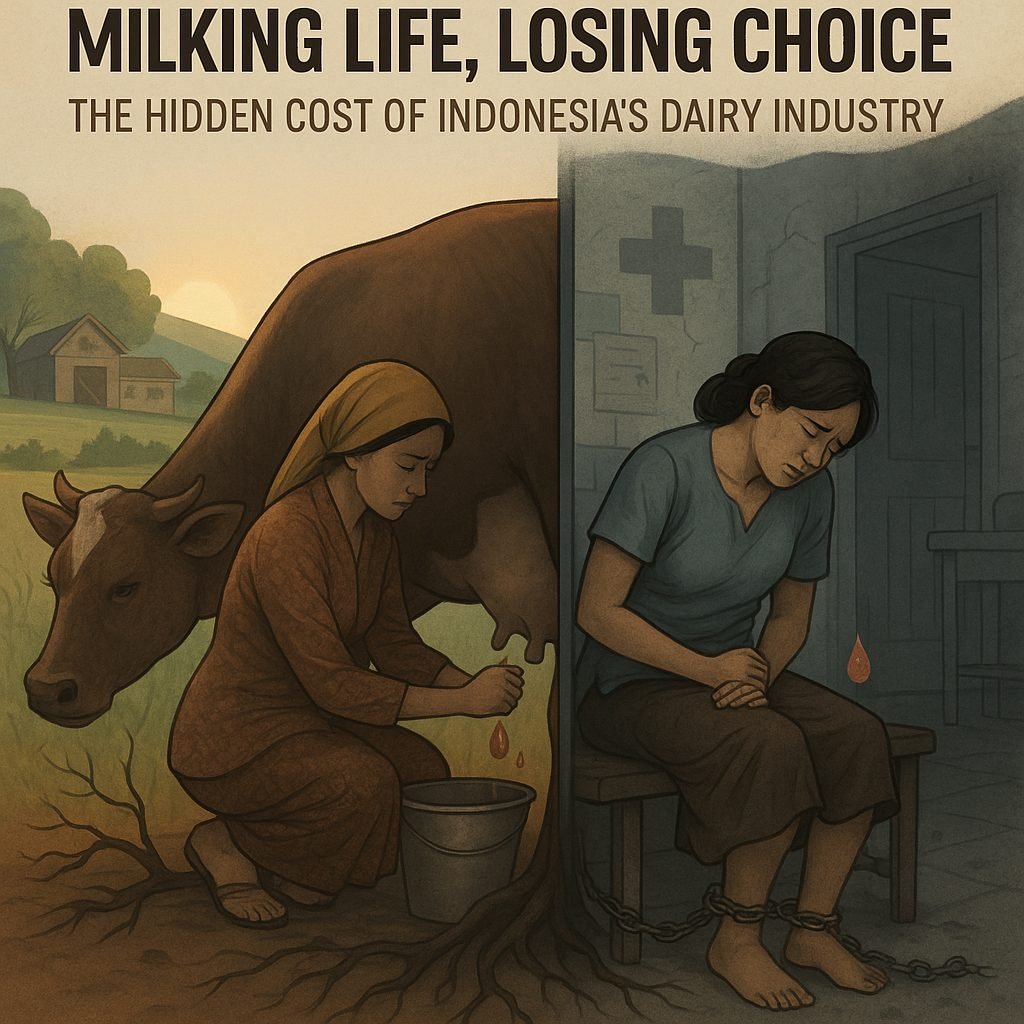
In Indonesia’s dairy communities, a cruel irony thrives: the women who produce nutrient-rich milk often cannot afford to drink it. 42% of dairy-working mothers in East Java suffer from chronic malnutrition, compared to 28% nationally (Indonesian Health Ministry, 2023). And even if they drink it, do you think milk really is the only superfood they need?
The Hidden Hunger
- Dairy Access: Only 15% of smallholder families regularly consume milk, as they sell 90% of their yield to corporate buyers (FAO, 2022). Besides, a litre of milk costs nearly a day’s wage for most women.
- Staple Diets: Women rely on rice, tempeh, and instant noodles, lacking calcium, iron, and protein. So, approximately 58% of pregnant women in dairy regions fail to meet minimum dietary diversity standards (World Food Programme, 2023).
Anaemia and Maternal Mortality
Approximately 36% of pregnant women in dairy communities are anaemic, versus 21% in urban areas (Indonesian Health Ministry, 2023). Furthermore, chronic iron deficiency increases the risks of haemorrhage during childbirth, a leading cause of maternal death. Even when considering abortion, there is a risk of heavy bleeding which can create complications for anaemic women. Some may even need blood transfusion to save their lives.
Besides the time for healthcare needs and proper care, they often lack finances for good medicines and supplements to make up for the blood loss. Of course, in the first place, they lack nutritious food eliminating the need for medicines or supplements. So, anaemia is a big complication and very common in Indonesian women, especially the rural areas and the ones serving the country’s dairy industry at low-profile jobs.
Malnourished women face 3x higher rates of preterm birth and low infant birth weights (Lancet Global Health, 2021). These complications often force desperate choices, including unsafe abortions.
“I sold milk to pay for my daughter’s hospital bills, but I couldn’t afford eggs for her recovery.”
— Rina, 29, a dairy farmer in Boyolali.
The Milk Myth: Nutritional Gaps in Local Dairy Production
While milk is celebrated as a nutritional powerhouse globally, the truth lies in the exact nutritional values. The milk these women produce often lacks the fortification and safety standards needed to address maternal health crises—and in some cases, exacerbates them.
Over 60% of smallholder milk sold to cooperatives is unpasteurized and unfortified, lacking essential vitamins like D and B12 added in commercial processing (FAO, 2022). Additionally, without pasteurization, harmful bacteria like Salmonella and E. coli persist, posing severe risks to pregnant women.
Corporate buyers often convert raw milk into powdered or sweetened condensed milk, stripping it of 40–60% of its natural calcium and protein during high-heat treatments (Indonesian Dairy Association, 2023).
Is milk a complete food?
Milk, often hailed as a “complete food,” carries a hidden irony in Indonesia’s dairy communities: the very women who produce it rarely benefit from its touted nutritional promise. While milk provides calcium and protein, it lacks critical nutrients like iron—a deficiency that deepens anaemia rates and complicates reproductive health crises.
For smallholder farmers, drinking raw, unfortified milk from their cows offers little defence against malnutrition. Milk’s natural composition contains zero iron, and its calcium can even block iron absorption from other foods, worsening anaemia in women already surviving on nutrient-poor diets. In regions like East Java, where 1 in 3 women are anaemic, relying on milk as a dietary staple becomes a silent trap.
“We drink milk every day, but I still faint during my period. The midwife says my blood is too thin.”
— Sari, 31, dairy farmer and mother of two.
This is a story of a normal menstrual period, imagine heavy bleeding risk after an abortion in Indonesia.
This iron deficit isn’t just a dietary gap—it’s a life-threatening multiplier. Anaemic women who resort to unsafe abortions (often performed with herbal concoctions or unsterile tools) face catastrophic bleeding. Without enough red blood cells to carry oxygen, their bodies struggle to recover, leading to complications like organ failure or sepsis.
Poor nutrition exacerbates reproductive health crises. Malnourished women are more likely to experience:
- Unplanned Pregnancies: Weakness and fatigue reduce contraceptive adherence.
- High-Risk Abortions: Faced with unsustainable pregnancies, women resort to unsafe methods. 1 in 4 maternal deaths in dairy regions is tied to post-abortion sepsis (Guttmacher Institute, 2023).
Contamination Risks
- Antibiotic Residues: Smallholders routinely inject cows with antibiotics to boost yield, leaving traces in milk. A 2022 study found that 17% of raw milk samples from East Java exceeded safe antibiotic limits, linked to disrupted gut health and antibiotic resistance in consumers (University of Gadjah Mada, 2022). Most women after abortion require prophylactic antibiotics. Imagine the antibiotics not working due to antibiotic resistance, further exaggerating the medical condition instead of alleviating it.
- Aflatoxins: Poor storage in humid climates contaminates milk with carcinogenic moulds. 1 in 5 dairy households in West Java reported mouldy feed, correlating with liver damage in long-term consumers (Indonesian Food and Drug Agency, 2023).
This nutritional double bind—where milk fails to nourish those who produce it—underscores how systemic inequities transcend mere access. Even when women can consume dairy, its compromised quality and marketing myths leave them trapped in cycles of poor health.
Grassroots Solutions
Milk alone cannot reverse anaemia or offset the physical toll of dairy labour. Corporate processing strips milk of nutrients like vitamin D and B12, further diluting its value. Cultural and marketing myths that equate milk with “strength” often overshadow urgent needs for iron-rich foods like leafy greens or eggs—foods many women cannot afford.
Women’s cooperatives grow iron-rich spinach and moringa, improving dietary diversity in community gardens, indeed a good initiative if women have easy access to them of course.
The lesson is clear: Milk, in this context, is not a lifeline. True nourishment requires systemic change—not just more dairy, but better food, safer healthcare, and fairer access to both. Malnutrition is just one thread in a tangled web of inequity. In the following section, we’ll confront Indonesia’s restrictive abortion laws—and how economic precarity traps women in cycles of risk.
Abortion in Indonesia: Legal Shifts and Harsh Realities
Indonesia’s abortion laws have inched toward compassion—but not without contradictions. In 2024, President Joko Widodo signed a new regulation permitting abortion up to 14 weeks’ gestation in cases of rape or medical emergencies, expanding from the previous 6-week limit (Bloomberg, 2024). While this marks progress for survivors of sexual violence, the law remains punitive: abortion outside these narrow exceptions is still criminalized, punishable by up to four years in jail. For women in dairy communities, where stigma and poverty collide, this “reform” likely changes nothing.
The Gap Between Law and Survival
The updated law responds to tragedies like the 2018 case of a Javanese teenager jailed for aborting a pregnancy resulting from her brother’s rape—a verdict overturned only after public outrage (Bloomberg, 2024). Yet rural women, especially in dairy regions, still face brutal choices:
- Delayed Access: Survivors of rape often take weeks to report due to shame, missing the 14-week cut off.
- Permissible Scenarios: Abortion in Indonesia is not available if a woman wants it as a choice. Sad, but true!
- Medical Deserts: Indonesia has only 6 doctors per 10,000 people (vs. 8.6 in India), and rural clinics lack staff trained to perform legal abortions (World Bank, 2024). The WHO notes that 70% of India’s doctors cluster in cities. Bangalore, an Indian metropolitan city is worth visiting for an abortion in India rather than an unsafe abortion in Indonesia.
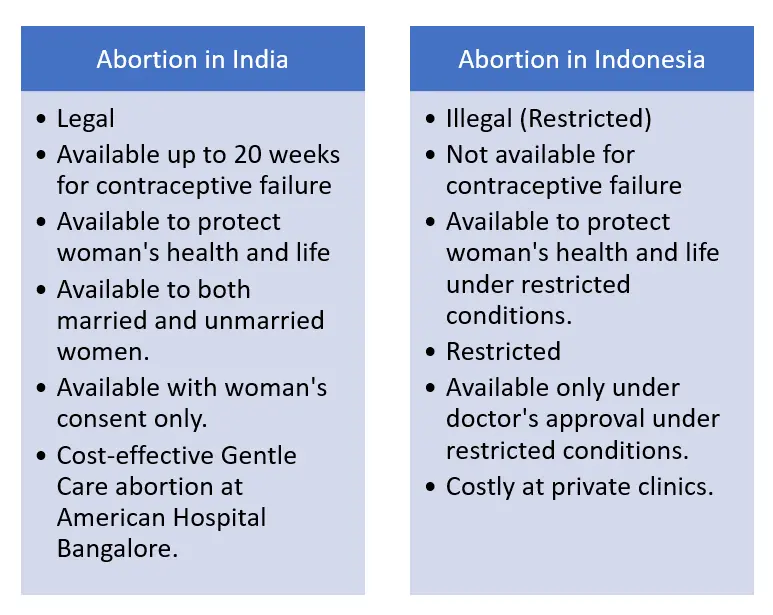
Abortion in Indonesia
Unsafe Abortions: A Persistent Crisis
Despite the reforms, 1.7 million abortions occur annually in Java alone, the most unsafe (2018 Java Study, cited by Bloomberg, 2024). Dairy workers, already weakened by anaemia and malnutrition, risk lethal complications:
- Herbal Poisons: Women ingest bitter pineapple or tamarind seeds or raw papaya for abortion causing haemorrhage and other complications.
- Unsterile Tools: Unlicensed providers use bamboo sticks or knitting needles, charging IDR 1 million ($65)—a month’s wage for many. Besides, the health risks from unsafe practices can cost them lost reproductive health and even life, which stays true for many women.
Of course, legal repercussions and a hard blow to social and professional life add to the devastation for most women.
Maternal Mortality: A Regional Stain
Indonesia’s maternal mortality ratio remains at 140 deaths per 100,000 live births (“Trends in maternal mortality estimates 2000 to 2023″ report released in 2025). For anaemic women in dairy zones, post-abortion bleeding is often a death sentence: clinics lack blood banks, and families sell cows to fund transfusions.
Stigma
87% of Indonesians deem abortion “immoral” outside legal exceptions (Pew, 2023), silencing survivors.
Economic Ties: Dairy Income and Healthcare Access
In Indonesia’s dairy belt, women’s health is held hostage by pennies and cows. Smallholder farmers earn too little even to make both ends meet, a pittance that chains them to cycles of poverty and poor healthcare access (Central Statistics Agency/BPS, 2023). For women balancing milking quotas and motherhood, even basic prenatal care becomes a luxury, let alone safe abortion services.
Healthcare Expenses:
A single prenatal check up costs nearly a week’s wages (Indonesian Health Ministry, 2023).
Abortion Economics:
Safe abortion services in private clinics run too high but are only available for those who comply with abortion laws. Wait a minute! What about contraceptive failure if a woman doesn’t want a child due to socioeconomic conditions? Not to forget, if the unplanned pregnancy termination is a choice.
Adding another peel of complexity, what if an unmarried girl gets pregnant and wants an abortion? For most women, including dairy workers, “choice” is a myth, especially when they cannot afford the cost of abortion nor the expenses childbearing will bring along. However, a safe abortion can prevent additional costs one may have to pay for complications. For instance, abortion pills may fail resulting in incomplete abortion necessitating further procedures and days off. Meaning health lost and wages lost in addition to paying twice or more for the abortion.
“I sold two goats to pay for my sister’s abortion. Now we have no milk to sell. How will we eat?”
— Rini, 26, a dairy farmer in Wonosobo.
Debt Traps and Desperation
- Loans for Healthcare: 62% of dairy households borrow money from cooperatives or loan sharks to cover medical emergencies, accruing interest rates of 20–30% monthly (University of Indonesia, 2023).
- Childcare Trade-offs: Mothers skip meals or pull children from school to afford antibiotics or postnatal care.
Economic barriers are just one layer of the crisis. In the following section, we’ll confront how cultural stigma in dairy communities silences women, trapping them in shame and secrecy.
Cultural Stigma: Dairy Communities and Reproductive Silence
In Indonesia’s dairy heartlands, silence is a survival tactic. Women whisper about miscarriages in code, hide contraceptive pills in rice sacks, and bury stories of unwanted pregnancies deep in the soil they till. Here, cultural norms and traditions equate reproductive autonomy with moral failure. For dairy workers, seeking healthcare often means risking ostracization, shame, or even violence.
The Weight of Conservatism
- Religious Judgment: Local clerics condemn abortion as haram (forbidden), and see it as a crime. Not only this, but also women who seek care face sermons branding them “sinful” or “unclean,” pushing them into secrecy (UNFPA Indonesia, 2023).
- Marital Control: Husbands and elders often dictate reproductive choices. 62% of dairy women report needing spousal permission to visit clinics even for contraception needs, while unmarried pregnant teens face expulsion from families (NGO Aksi Keadilan Indonesia, 2022). Where there is lack of sex education and contraception, what to expect for a woman seeking abortion? The reality is really pushing many women to unsafe choices and also lost reproductive freedom and health.
The Education Void
- Sexual Health Myths: Only 12% of rural dairy communities have access to formal sex education. Many girls grow up believing breastfeeding prevents pregnancy or that contraceptives cause infertility (Indonesian Health Ministry, 2023).
- Clinic Stigma: Posters in village clinics often depict abortion as “murder,” deterring women from asking for help. Midwives report that 45% of patients lie about symptoms to avoid suspicion (Oxfam Indonesia, 2023).
Silence Breeds Danger
Stigma doesn’t just shame—it kills. Fear of judgment drives women to:
- DIY Abortions: Swallowing bitter pineapple pulp, inserting chilli paste into the cervix or consuming large amounts of raw papaya, methods passed through hushed networks.
- Avoid Post-Care: 1 in 4 women with post-abortion complications delay treatment until sepsis sets in, fearing clinic staff will report them (Guttmacher Institute, 2023).
Cultural stigma thrives on the soil of economic and legal neglect. When women cannot afford healthcare or access safe services, shame becomes a weapon. Yet, as one activist in Wonosobo notes:
“Silence is not surrender. Every woman who shares her story chips away at the stigma.”
We too welcome stories of our patients that can inspire and protect many others in similar situations. You too can share your story and we can put it on our Instagram story page sharing a link with you too. For us at American Hospital Bangalore, even if a single woman gets the message and chooses a safe abortion over an unsafe one, we will be grateful to the almighty to have been able to save a woman’s choice, her health and reproductive freedom.
Safe, Legal, and Accessible: Why Indian Abortion Clinics Are a Lifeline for Indonesian Women?
In Indonesia, abortion remains heavily restricted—permitted only in cases of rape, severe fetal abnormality, or life-threatening health risks to the woman. Even then, access is limited, burdened by long approval processes, stigma, and a lack of trained providers. As a result, many women are pushed toward unsafe, unregulated procedures—putting their health and future at grave risk.
In contrast, India offers a supportive and legal environment for abortion care. Women—regardless of nationality or marital status—can access safe, confidential, and medically approved abortions up to 20 weeks (and even later under special conditions), without needing spousal or parental approval.
For Indonesian women working in demanding sectors like dairy or agriculture, where time off means losing crucial income, India’s Gentle Care suction abortion offers an ideal solution. It is a quick, outpatient procedure that typically takes less than 30 minutes, with recovery often within a day or two. Women can travel discreetly, undergo the procedure, and resume their normal routine without long downtimes or fear of complications.
Choosing a safe and legal abortion in a registered Indian abortion clinic not only protects a woman’s health—it can also protect her job, her privacy, and her dignity. In a world where unsafe abortions still claim thousands of lives each year, accessing the right care at the right place can make all the difference.
Reach out for a safe, legal & confidential abortion.
Related Posts:
- Abortion in Indonesia: Do you have a safe choice?
- Abortion in Indonesia: Legal, Safe Options & Travel Guidance – 2025
- Managing Self-Induced Abortion at Home: Dos and Don’ts
- Abortion Success Rates: Comparing Medical vs Suction Methods
- What to do Next Once you Arrive at the Airport for Abortion in India?
Quick Links:
- American Hospital Bangalore: Reviews & Patient Experiences
- What to expect from period after abortion? When to Worry?
- Clearblue Pregnancy Test Results: Is the Positive Bothering You?
- Can you take abortion pills while breastfeeding? UAE doctor speaks up
- Can abortion cause infertility? Doctor Speaks Up


Leave a Comment