

Abortion Success Rates: Comparing Medical vs Suction Methods
Contents of This Post:
- Understanding Abortion Methods: Medical vs. In-Clinic
- How Success Rates Are Measured?
- Factors That Can Impact Abortion Success
- What Happens If an Abortion Fails?
- Choosing the Right Option Based on Success Rates
Choosing the right abortion method can feel overwhelming, especially when you are either getting it for the first time or you are unaware of the available options. One of the biggest concerns is how effective each option is because the ultimate want is to have a successful procedure. Success rates matter because they determine whether the method will work as expected or if further medical care will be necessary.
Both medical and suction (aspiration) abortions are in wide use, but their effectiveness varies. Medical abortion, using pills like Cytotec (misoprostol) and mifepristone or combinations like Unwanted Kit, works differently from an in-clinic suction procedure. Factors like pregnancy duration, dosage, and individual health can impact success rates.
This post breaks down the effectiveness of each method, comparing their success rates and what influences them. Understanding these numbers can help you make an informed choice. Whether you’re considering abortion or just exploring options, this guide will provide clear, fact-based insights. So, you will know what to expect and prepare accordingly.
Understanding Abortion Methods: Medical Abortion vs. In-Clinic Suction Abortion:
Abortion is a personal decision. And choosing the right method is important, both for the procedure’s success and long-term health. The two main types of abortion are medical and in-clinic (suction or aspiration abortion). Furthermore, surgical abortion with Dilatation & Curettage (D&C) or Dilatation & Evacuation (D&E) are also available options for terminating late-term pregnancies.
We shall however be discussing medical abortion and suction abortion in this post by and large. Surgical abortions are usually nearly 100% efficient. However, it is necessary that highly experienced gynaecologists perform such procedures for precision, accuracy and safety.
Now, coming back to medical and suction abortion. Each works differently and has its own success rate. Understanding how they function helps in making an informed choice.
Medical Abortion: How It Works?
Medical abortion uses medicine pills (tablets) to end a pregnancy. The process involves two medications: mifepristone and misoprostol (Cytotec). In some cases, the doctor may use Cytotec alone but in most cases, the preferred course is the combination. These pills work together to stop the pregnancy and expel it from the uterus just like a natural miscarriage or spontaneous abortion.
Step 1: Taking Mifepristone:
This medicine helps in blocking the pregnancy hormone, progesterone, the hormone needed for pregnancy to continue. Without it, the pregnancy stops growing, which is the first stage of medical abortion.
Step 2: Taking Misoprostol:
After 24–48 hours or as the doctor may guide, misoprostol is taken to trigger uterine contractions. These contractions of the uterine muscles cause the uterus to expel the pregnancy, similar to a miscarriage or monthly menstruation. However, the cramps are usually more severe than menstrual cramps due to the thicker uterine wall at the time of developing pregnancy.
Step 3: Bleeding and Cramping:
The body pushes out pregnancy tissue through heavy bleeding and cramps. This usually happens within a few hours of taking misoprostol. While most women start to bleed in less than an hour, some may take as long as four hours. But, beyond this, you will need to discuss it with your abortion doctor and proceed as per her opinion.
Medical abortion is most effective in the early stages of pregnancy, up to 6 weeks. After this period, the success rate decreases, and the chances of needing a follow-up procedure increase. So, as the gestation age increases, the risk of incomplete abortion with the medical method of abortion increases and hence, doctors prefer suction abortion, which is an available abortion method for up to 12 weeks. Let’s now see if its working.
In-Clinic (Suction/Aspiration) Abortion: How It Works?
In-clinic abortion, also called suction or aspiration abortion, is a minor surgical procedure. However, it is also available without any surgery, a non-invasive approach of suction abortion, going by the name Gentle Care suction abortion, available as an abortion in India technique at the best abortion clinic for married and unmarried women, American Hospital Bangalore (AHB).
It is done by a trained doctor in a medical setting. The procedure is quick and removes the pregnancy from the uterus using gentle suction. The doctor can choose to create the suction either manually or using an electric aspirator.
The choice of Manual Vacuum Aspiration (MVA) versus Electric Vacuum Aspiration (EVA) depends on the availability, training of the abortion doctor and also patient specifics. The doctor weighs in all the factors to decide the best approach for creating suction to remove the pregnancy tissue successfully.
Step 1: Preparing the Cervix:
The doctor may give medication to soften and open the cervix. This makes the procedure easier and reduces discomfort. Furthermore, the doctor may either administer anaesthesia or mild sedation, again depending on the patient’s needs to make the process further comfortable and painless.
Step 2: Suction Process:
The doctor gently inserts a thin tube into the uterus through the vagina. Then, the suction device removes the pregnancy tissue very gently. Since the tissue is small, the time taken is also very less, between 5-15 minutes depending on the exact pregnancy length and some patient-specific factors.
Step 3: Recovery:
Most people rest for a short time before going home. At a private abortion centre in India, patients get a private room to recover fully furnished and equipped with facilities for a comfortable stay.
Suction abortion is typically available for up to 12-14 weeks of pregnancy. It is highly effective and has a low risk of complications.
Key Differences Between Medical and Suction Abortion:

Gentle Care suction abortion vs Medical abortion
Method – Medical abortion uses pills, while suction abortion is a minor procedure.
Timeframe – Medical abortion is most effective up to 6 weeks, while suction abortion works up to 12-14 weeks.
Process Duration – Medical abortion takes a few days, while suction abortion completes in a single visit.
Bleeding and Pain – Medical abortion causes heavy bleeding and cramping at home. Suction abortion involves less bleeding and cramping, as the doctor removes the tissue in the clinic itself.
Effectiveness – Suction abortion has a higher success rate, often over 99%. Medical abortion is about 92-93% effective in early pregnancy.
Both methods are safe and effective. The choice depends on personal preference, medical history, and how far along the pregnancy is. Understanding these options helps in making a confident and informed decision.
How Abortion Success Rates Are Measured?
Success rates help determine how effective an abortion method is. They show how often a procedure works without needing extra treatment. Medical and in-clinic abortions have high success rates, but several factors influence the outcome.
What Defines a Successful Abortion?
An abortion is considered successful when the pregnancy is completely terminated without the need for additional medical intervention. This means:
- The procedure effectively expels all pregnancy tissue.
- No surgical procedure needed afterwards.
- No ongoing pregnancy remains.
If the abortion does not fully remove the pregnancy, it is an incomplete abortion. In such cases, further treatment, like additional medication or a suction procedure or D&C or D&E, may be essential.
Measuring Success Rates in Medical Abortion:
Medical abortion relies on abortion pills to terminate a pregnancy. Its success rate depends on gestational age, correct dosage, and body response.
Early Pregnancy (Up to 6 Weeks) – Success rates are about 92-93% when both mifepristone and misoprostol are used correctly.
9-10 Weeks – Effectiveness significantly decreases to around 85-90%.
After 10 Weeks – The chances of incomplete abortion rise, and medical supervision is often needed. Doctors do not recommend abortion pills beyond 6 weeks in most cases.
Signs of a Successful Medical Abortion:
- Heavy bleeding with clots within a few hours of taking misoprostol.
- Severe cramping, similar to or stronger than a period.
- Pregnancy symptoms (nausea, breast tenderness) start to fade after a few days.
- Negative pregnancy test after 2-3 weeks.
When to Seek Medical Help?
- No bleeding within 24 hours of taking misoprostol.
- Severe pain that does not improve with medication.
- Fever over 100.4°F (38°C) lasting more than 24 hours.
- Very heavy bleeding (soaking more than 2 pads per hour for 2 hours).
- Signs of ongoing pregnancy after 2 weeks.
Doctors measure success by confirming the absence of pregnancy tissue. This can be done through:
- Ultrasound Scan – Checks if the uterus is empty.
- Blood Tests (hCG Levels) – Measures pregnancy hormones to ensure they are dropping.
If bleeding stops too soon or symptoms of pregnancy continue, the abortion may be incomplete. In such cases, additional procedure is often the last resort.
Medical abortion is safe and effective for most people. However, understanding how to use the medication correctly and knowing what to expect can improve success and reduce complications.
Measuring Success Rates in Suction Abortion:
Suction abortion has a very high success rate, often over 99%. Since a doctor physically removes the pregnancy tissue, the chances of an incomplete abortion are very low.
The procedure is performed by trained professionals, reducing the risk of failure. Besides, the uterus is immediately emptied, so follow-up treatment is rarely needed. There is a very low chance of needing a second procedure because the pregnancy is physically removed.
Unlike medical abortion, suction abortion does not rely on the body to expel the pregnancy. This makes it a more controlled and predictable process.
Doctors confirm success right after the procedure by checking for complete removal of tissue. If any remains, a second suction procedure may be done immediately. So, the entire procedure completes in a single visit unlike with pills which may need days or weeks to complete. This is the biggest reason why foreigners prefer Gentle Care suction abortion at AHB with an assurance of a complete procedure in a single visit. Have a look at American Hospital Bangalore reviews and testimonials of previously treated patients.
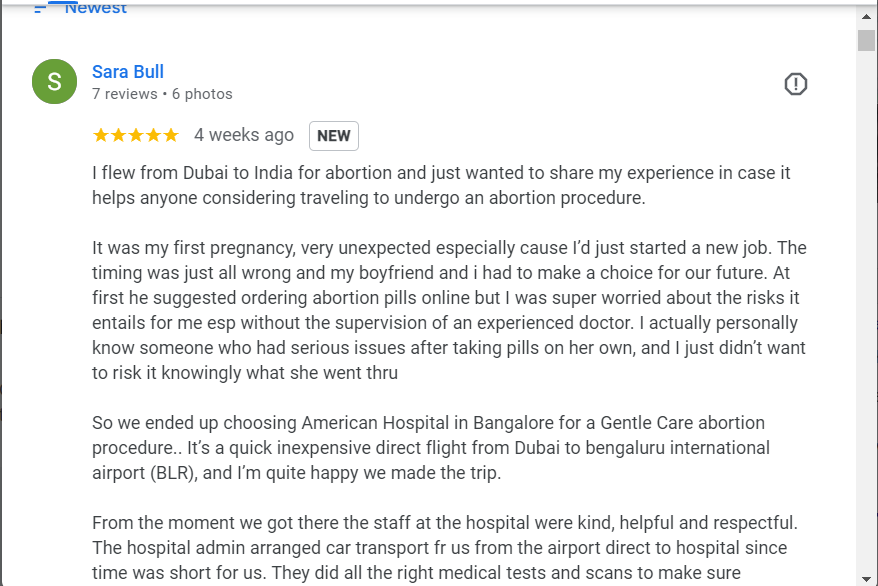
Dubai patient abortion in India
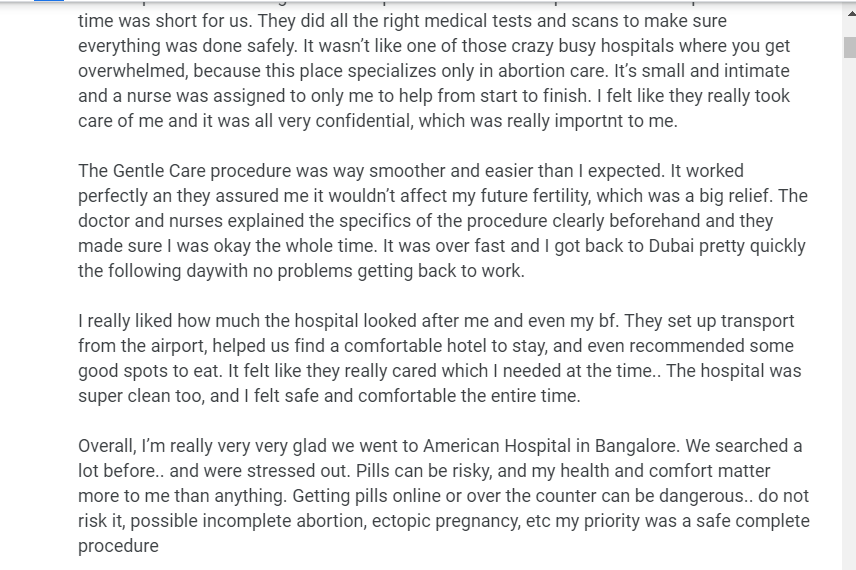
Dubai patient abortion in India
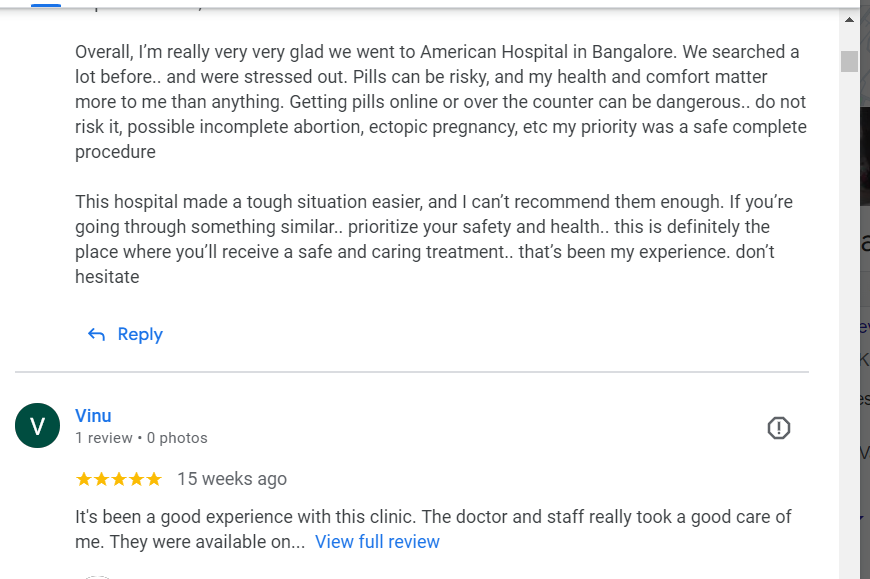
Also, many countries like the UAE, Maldives, Kuwait, Oman, Bahrain, Bhutan, Sri Lanka, the Philippines, Singapore, Indonesia, Mauritius and others have restricted abortion rules. Patients from these countries can conveniently obtain successful single-visit abortion in India at American Hospital Bangalore.
Signs of a Successful Suction Abortion:
- Minimal cramping and light bleeding after the procedure.
- Immediate relief from pregnancy symptoms.
- No heavy bleeding or strong pain after leaving the clinic.
- A negative pregnancy test after 2-3 weeks.
When to Seek Medical Help?
- Severe pain or cramping that does not improve with pain medication.
- Heavy bleeding (soaking more than two pads per hour for more than two hours).
- Fever over 100.4°F (38°C) lasting more than 24 hours.
- Strong, unusual vaginal odour or severe discomfort.
Suction abortion is one of the safest and most effective abortion methods. It provides quick results with minimal risk of complications. Since it is done in a medical setting, it offers a reliable option for those seeking a highly effective procedure.
Factors That Affect Abortion Success:
- Pregnancy Duration – The earlier the abortion, the higher the success rate. So, delaying increases the risk of incomplete abortion.
- Correct Medication Use – In medical abortion, taking the right dosage at the right time improves effectiveness. Besides, skipping or delaying doses reduces effectiveness.
- Health Conditions – Conditions like obesity or certain medical issues can affect how the body processes abortion pills. Uterine conditions, such as fibroids, can impact how well the uterus expels pregnancy tissue. Besides, medications that affect hormone levels can reduce success. People with anaemia, blood clotting disorders, or severe infections should consult the doctor as medical abortion may not be a good option for such individuals.
- Misoprostol Absorption – Pills taken orally may be slightly less effective than those used vaginally or sublingually. Oral use (swallowing the pill) is slightly less effective due to digestion.
- Provider Experience – In suction abortion, a skilled provider ensures the complete removal of pregnancy tissue.
Both medical and suction abortions have high success rates. However, suction abortion is slightly more reliable since it is performed under medical supervision. Choosing the right method depends on personal preference, pregnancy stage, and medical factors.
What Happens If an Abortion Fails?
Although both medical and suction abortions have high success rates, there is a small chance that the procedure may not work completely. A failed or incomplete abortion means that some pregnancy tissue remains in the uterus, or rare cases, the pregnancy continues. If this happens, follow-up care is necessary to prevent complications.
How to Know If an Abortion Has Failed?
Signs of an incomplete or failed abortion may include:
- No bleeding or very light bleeding after taking misoprostol (for medical abortion).
- Pregnancy symptoms (nausea, breast tenderness) persist after 1-2 weeks.
- A positive pregnancy test even after two weeks of the abortion.
- Severe or prolonged pain that does not improve with pain relief medication.
- Heavy bleeding with large clots for several days.
- Fever, chills, or unusual vaginal discharge, which may indicate an infection.
A healthcare provider may confirm an incomplete abortion through an ultrasound scan or a blood test to check hCG hormone levels.
Risks of Not Treating an Incomplete Abortion:
Leaving an incomplete abortion untreated can lead to complications such as:
- Infection (septic abortion) – Bacteria can enter the uterus, causing fever, chills, and pelvic pain. It can also result in conditions such as chronic Pelvic Inflammatory Disease (PID) which can make it difficult to conceive in future, contributing to infertility. And an untreated infection can also result in sepsis, which can be life-threatening.
- Excessive bleeding (haemorrhage) – If tissue remains in the uterus, bleeding may continue for weeks.
- Severe pain – The uterus may continue to contract, causing discomfort and cramping.
If an abortion fails, seeking medical attention quickly is essential to prevent complications. In most cases, a follow-up treatment resolves the issue safely.
How to Reduce the Risk of an Incomplete Abortion?
- Follow all medication instructions carefully when choosing a medical abortion.
- Use the correct method of taking misoprostol (vaginal or sublingual methods are often more effective than oral swallowing).
- Have access to follow-up care in case additional treatment is needed.
- Choose suction abortion if a higher success rate is a priority.
Both medical and suction abortions are safe, but it is important to recognize signs of failure and seek medical care if needed. Prompt treatment ensures a safe and complete abortion process.
Choosing the Right Option Based on Success Rates:
When deciding between medical and suction abortion, success rate is an important factor. Both methods are highly effective, but suction abortion has a higher and more predictable success rate. However, the best choice depends on personal preference, pregnancy stage, and access to medical care.
When Medical Abortion May Be Your Choice?
Medical abortion using pills is a good option for those who:
- Prefer an abortion method that can be done at home.
- Are in early pregnancy (up to 4-6 weeks) when success rates are highest and the pregnancy is intrauterine.
- Have access to follow-up care in case an extra dose of misoprostol or a suction procedure is needed.
- Are comfortable with heavier bleeding and cramping, which can last several hours to days.
However, medical abortion has a 5-7% failure rate, meaning some people may need additional treatment. If maximizing success on the first attempt is a priority, suction abortion may be a better option. So, if you are thinking of abortion pills, you should also consider the risk of incomplete abortion and the want of an additional surgical procedure in such a case.
When Suction Abortion May Be the Better Choice?
Suction abortion is often recommended for those who:
- Want the most reliable method with a 99%+ success rate.
- Prefer a quick procedure that is completed in minutes.
- Are less than 12 weeks pregnant, when medical abortion becomes less effective.
- Want immediate confirmation that the abortion is complete, rather than waiting for symptoms to appear.
- Have a medical condition (such as bleeding disorders) that makes heavy bleeding riskier.
Suction abortion provides immediate results, unlike medical abortion, which can take several days to complete.
Key Takeaways: Which Method Is More Effective?
If success rate is the top priority → Suction abortion is the better option.
If avoiding a procedure is more important → Medical abortion is still effective but may require follow-up care.
The earlier in pregnancy, the higher the success rate for both methods.
Regardless of the choice, both medical and suction abortions are safe and effective when performed correctly. Consulting a healthcare provider can help determine the best option based on individual needs.
Schedule an abortion appointment.
Related Posts:
- What to expect from period after abortion? When to Worry?
- Medical or Suction abortion method: What may be best for you
- Cost of abortion: Medical vs Surgical methods of abortion
- Can abortion cause infertility? Doctor Speaks Up
- Is abortion illegal in India: What you should know?


Leave a Comment