

Late Period? Is it Burnout or Something More?
Contents of This Post:
- Firstly, you need to understand the “Panic Spiral”: Why We Assume the Worst?
- Secondly, understand the science: How Stress Hijacks Your Hormones?
- Then, Discover How Long Can Stress Actually Delay a Period?
- Next, Learn Differences Between Stress vs. Early Pregnancy: How to Spot the Difference?
- Now, Do Not Underestimate the False Negatives: Can Stress Hide a Pregnancy?
- Next, Understand the Action Plan: When to Take a Test (and Which One)?
- Additionally, Discover the Role of Nutrition and ‘Quick Fixes’: Why Home Remedies Don’t Work?
- Finally, The Reality Check: What if the Test Is Positive? Is Abortion in India an Option?
The “Panic Spiral” is Universal
You know the feeling when you check the calendar, and your heart skips a beat. Why? Because you are late.
Suddenly, every small ache feels like a symptom. Then, you start counting days, retracing your steps, and asking yourself the same frantic question: “Am I pregnant, or am I just stressed, or is it the fear of an unwanted pregnancy stressing me out?”
It is a scenario that plays out in bathrooms across the world every single day. Whether you are a corporate executive in Dubai, a student in London, an IT professional in Bangalore, a student in a university, a teacher at a school, a lawyer, a chef, a pharmacist, a coach, a judge, or a homemaker, your body responds to burnout in the same way.
Stress does not discriminate based on your nationality, religion, or tax bracket. Besides, when life gets overwhelming—whether it’s due to a high-pressure job, family expectations, or just the chaos of modern living—your body often hits the “pause” button on your reproductive system to protect you.
But how do you tell the difference between a body shouting “I need a break!” and a body saying “I’m pregnant”?
In this post, we will break down exactly how stress hijacks your hormones, why your period plays hide-and-seek, and when you actually need to take that test.
The Science: How Stress Hijacks Your Hormones?
You might think your period is controlled strictly by your ovaries, but the real “boss” of your menstrual cycle is actually your brain—specifically, a command centre called the Hypothalamus.
Under normal circumstances, your Hypothalamus acts like a punctual train conductor. It sends a steady signal to your pituitary gland to release hormones (like LH and FSH) that tell your ovaries: “Okay, release an egg. It’s time.” This is ovulation, and about 14 days later, if that egg isn’t fertilised, you get your period.
But here is what happens when you are stressed:
When you are overworked, anxious, or not sleeping, your body perceives it as a physical threat. It doesn’t know the difference between “I have a deadline tomorrow” and “I am being chased by a tiger.”
In response, your body floods your system with Cortisol (the stress hormone). This then puts your body into “Survival Mode.”
Then, your brain then makes a strategic decision: “We are under attack which makes this time unsuitable and unsafe to reproduce.”
Now, to protect you, your brain temporarily shuts down “non-essential services”—and unfortunately, reproduction is at the top of that list. So, your hypothalamus stops sending the signal to ovulate.
Now the result? If you don’t ovulate, the countdown to your period never starts. So, your cycle is literally “on pause” until your brain feels safe again. This is why you can be two weeks late without being pregnant—your body is simply waiting for the stress to pass before it resumes business as usual.
How Long Can Stress Actually Delay a Period?
This is the question everyone asks while staring at the calendar: “Is this a two-day delay, or am I going to skip this month entirely or something worse waiting for me?”
The frustrating answer is that it depends entirely on when the stress hits you during your cycle.
Here is the breakdown of what is likely happening inside your body:
Firstly, the “Short Delay” (A Few Days to a Week Delay in Your Periods):
If you experienced a spike in stress just before you were supposed to ovulate (usually mid-cycle), your body might have simply hit the “snooze” button on ovulation.
So, the Result: You ovulate a few days late.
Now, Understand the Math: Since your period always comes about 14 days after ovulation, your period will be late by that same number of days. So, if you ovulated 5 days late, your period will be 5 days late.
The “Skipped Period” (Amenorrhea):
If the stress is chronic—meaning you have been in “survival mode” for weeks (long-term burnout, a major life event, or severe anxiety)—your brain might cancel ovulation entirely for this month.
The Medical Term: This is often called Functional Hypothalamic Amenorrhea.
The Result: You won’t get a period at all this month. So, you might not see a bleed until your next cycle, provided your stress levels drop.
The “Compound Effect” (Stress + Lifestyle):
Stress rarely travels alone. When you are overwhelmed, you are likely to change your routine as well.
- Firstly, Diet: Are you eating more comfort food (sugar/carbs) or skipping meals entirely?
- Secondly, Sleep: Are you losing sleep or waking up frequently?
- Then, Travel: Did you cross time zones or change your environment?
These lifestyle shifts act like a multiplier. Stress signals your brain to pause, and poor nutrition or lack of sleep confirms that the environment isn’t safe. This combination is the most common reason for a significant delay (nearly 10+ days).
A Crucial Note: Even if you are 99% sure it is stress, you cannot confirm that without a test. Besides, stress symptoms and early pregnancy symptoms are too similar to guess.
Stress vs. Early Pregnancy: Spotting the Difference
This is where it gets tricky. High cortisol levels can cause symptoms that look suspiciously like early pregnancy, which only makes you panic more (and creates more cortisol!). That’s why we mentioned that stress can delay your cycle but mimic an early unplanned pregnancy, causing more stress, and the symptoms get stronger.
However, both reasons can be true for a delayed period. What you need now is the fact because if it is stress, you need to take a chill pill. But if it really is an unplanned pregnancy, you need to decide what next.
Here is a quick cheat sheet to help you distinguish between the two:
| Symptom | If it’s Stress (Cortisol) | If it’s Pregnancy (HCG) |
| Appetite | You crave “comfort foods” (sugar/carbs) or lose your appetite entirely. |
You have specific aversions (e.g., the smell of coffee or garlic or tea suddenly makes you sick).
|
| Cramps | Generalized stomach knots or digestive issues (gas/bloating). |
Mild “tugging” or pulling sensation in the lower abdomen (Implantation cramping).
|
| Fatigue | You feel “wired but tired”—exhausted but can’t sleep at night. |
You feel “bone-tired” and could nap anywhere, anytime.
|
| Breast Changes | usually none, or mild tenderness similar to normal PMS. |
Heavy, sore, or sensitive breasts are often one of the very first signs of pregnancy.
|
| Nausea | Usually tied to anxiety (e.g., feeling sick before a meeting). |
“Morning sickness” can hit at any time of day and often happens without a specific trigger.
|
Key Takeaway: If you have nausea and sore breasts and are sensitive to smells, it is more likely to be pregnancy. If you are just late and tired, it might be burnout.
False Negatives: Can Stress Hide a Pregnancy?
One of the most common myths circulating on internet forums is that “stress hormones can interfere with a pregnancy test,” leading to a false negative.
Let’s clear this up with the medical facts:
Stress does not directly hide pregnancy hormones (hCG).
If you are pregnant, your body will produce human Chorionic Gonadotropin (hCG). Pregnancy tests are designed to detect this specific hormone. But stress hormones, like cortisol or adrenaline, have a completely different molecular “signature.” So, they do not block, mask, or neutralise hCG on a test strip.
However, stress can cause an indirect false negative. Here is how:
- Firstly, the “Late Ovulation” Trap: As we discussed, stress often delays ovulation. So, if you ovulated a week later than usual because of a stressful deadline, you might actually be pregnant, but it is “too early” to detect. While, you are testing based on your old calendar, but your body is working on a new one.
- Secondly, the Dilution Factor: When people are stressed or anxious, they often drink more fluids—whether it’s extra water, tea, or coffee. So, if you drink a lot of liquid right before taking a test, your urine becomes dilute which thins out the concentration of hCG, making it harder for a home kit to “catch” the hormone.
- Thirdly, Ectopic Pregnancy: Sometimes, ectopic pregnancy raises hCG levels abnormally compared to what is expected from a normal intrauterine pregnancy. In such events, hCG in urine may not be enough to be detectable by a home pregnancy test kit like Preganews, First Response, or Clearblue.
The Verdict: If the test is negative, but your period is still missing after another 3–4 days, test again. Stress didn’t change the chemistry of the test; it likely just changed the timing of your cycle. Finally, the best way is to get an early ultrasound. This will not only confirm whether you are pregnant or not, but also will check for the exact pregnancy length and location, if you happen to be carrying an unplanned pregnancy.
Action Plan: When to Take a Pregnancy Test (and Which One)?
If you are currently in the middle of a “panic spiral,” stop and follow these steps to get the most accurate answer possible.
- Firstly, Wait for the “Golden Window”: For the most reliable results, wait until at least one week after your period was supposed to start or Day 40 (for most women with a normal 28-32 day menstrual cycle). Testing the very first day you are late is often too early, especially if stress has shifted your ovulation.
- Secondly, the “First Morning” Rule: Always take the test as soon as you wake up because your first urine of the day has the highest concentration of hormones.
- Thirdly, Choose the Right Test: * Standard Strips: These are very accurate and affordable, but “faint lines” can be hard to read and cause more anxiety. So, use good-quality test kits like First Response or Clearblue.
- Fourthly, Digital Tests: These are excellent because they take away the guesswork as they clearly say “Pregnant” or “Not Pregnant.”
- Finally, Confirm with a Professional: If you have had two negative home tests but your period is still missing after 10 days, it is time to see a doctor. At our hospital, American Hospital Bangalore, we use clinical-grade blood tests (Beta-hCG) and ultrasounds to provide a 100% definitive answer. Not only this, if the pregnancy is unwanted, we also offer safe, legal and confidential abortion in India for all women coming from across the globe.
Sometimes, just hearing a doctor confirm a negative result provides enough mental relief for your stress levels to drop—and often, your period will arrive within 24–48 hours of that relief!
The Role of Nutrition and ‘Quick Fixes’: Why Home Remedies Don’t Work?
When the “panic spiral” sets in, it is tempting to look for a “natural” way to restart your cycle. Across different cultures—from the Middle East to South Asia—there are long-held beliefs that certain “hot” foods can jumpstart a late period.
You may have come across advice suggesting the consumption of large quantities of green papaya, pineapple, or the intake of strong home infusions made from ginger, cinnamon, parsley, or turmeric to “bring on” a delayed period. In many households, especially when a missed period raises anxiety, such suggestions often surface quickly—passed down through generations or shared in whispered conversations.
In some cases, the stress is even deeper.
When a mother discovers that her unmarried daughter has missed her period, fear of social stigma, judgment, and family pressure can take over. Besides, the worry is often less about health and more about how society might react. In that state of panic, well-meaning but misguided advice follows—drink strong coffee, take अजवाइन की फक्की (carom seeds), consume excessive turmeric, or try any number of home remedies believed to “fix the problem.” For a quick look and in fun manner, take a look at this YouTube shorts on how an unmarried girl’s mother worries when the girl has her periods delayed.
However, it is important to understand a clear medical fact: these methods do not work.
There is no scientific evidence that eating certain fruits, spices, or herbs can safely or reliably end a pregnancy or regulate a delayed period. What they can do, instead, is cause gastric irritation, dehydration, hormonal imbalance, or unnecessary physical stress—especially when consumed in excess.
More importantly, relying on such myths often delays seeking proper medical advice, increasing emotional distress and health risks. Besides, a missed period can occur for many reasons—stress, hormonal changes, weight fluctuations, or medical conditions—and assuming the cause without confirmation only adds to fear and confusion.
Additionally, healthcare decisions, especially those surrounded by emotional and social pressure, should never be driven by panic or misinformation. Accurate information, timely medical consultation, and compassionate guidance are far safer and more empowering than unproven home remedies rooted in fear and stigma.
The Medical Reality: Digestion vs. Menstruation
While a healthy diet is the foundation of hormonal balance, there is a major biological gap in the “food-as-a-fix” theory. Your digestive system and your reproductive system are separate. So, eating a pineapple may provide you with bromelain (an enzyme), but it does not have the hormonal “muscle” to override the Cortisol signals being sent from your brain delaying your period due to stress.
Similarly, papaya may give you papain, aiding in digestion, but too much of it can cause gastric irritation, if you happen to consume it in large quantities to induce a spontaneous abortion, if you believe your missed period may be because of an unwanted pregnancy.
The Vitamin C Myth:
Some claim that massive doses of Vitamin C can starve the uterus of progesterone. In reality, your kidneys will simply flush out the excess vitamin, and the only result is often a stomach ache or an increased risk of kidney stones—not a period.
The Danger of “Herbal Kits”:
On some international forums, women are told to use herbal “cleanses.” These can be incredibly dangerous, leading to liver toxicity or severe allergic reactions, especially if the ingredients are unverified. Some money-grubbing people claim them to be useful for desperate women in these trying times. But they only misguide and endanger the health and lives of trapped women.
The “Heat” Theory:
In many cultures, including India, foods like jaggery or sesame are called “heat-inducing.” While these are nutritious, your period is controlled by a complex drop in progesterone, not the temperature of your diet. Even abortion pill, Mifepristone deprives the body of Progesterone resulting in abortion.
Let us dig a little deeper because most people (such as an anxious mother) would say these are herbal or ayurvedic (tested and trusted theories) and will work for you. In Ayurveda, menstruation is governed by वात दोष (specifically अपान वायु, which controls downward movement) and पित्त दोष (which represents fire and transformation).
Ayurveda classifies certain foods as उशना वीर्या (having a “hot” potency). Examples include sesame seeds, jaggery, papaya, pineapple, and spicy peppers. The theory is that these “hot” foods increase पित्त and stimulate the blood (रक्त), which can theoretically help “clear” a delayed period caused by a cold or stagnant imbalance.
Ayurveda vs. Modern “Home Remedies”:
While Ayurveda recognises the potency of these foods, there is a major difference between Ayurvedic treatment and modern home myths:
- Firstly, the Cause Matters: Ayurveda does not suggest “hot foods” for every late period. If your period is late due to high stress (वात imbalance) or exhaustion (tissue depletion), eating “hot” foods can actually make the problem worse by causing more dryness and anxiety.
- Secondly, Dosage: Authentic Ayurveda uses balanced formulations. Modern home remedies often involve consuming “heroic” or excessive amounts of one food (like eating a lot of papaya), which Ayurveda would generally discourage as it can upset the digestive fire (अग्नि).
- Then, the Myth: People often hope “hot foods” act as a natural abortifacient (something that ends a pregnancy).
- Finally, the Fact: Medical science (and even traditional Ayurvedic practitioners) would agree that eating “heat-inducing” foods cannot stop a pregnancy.
So, while traditional systems like Ayurveda recognise ‘उशना’ (heat-inducing) foods for balancing the cycle, they are not a substitute for medical diagnostics. These foods cannot terminate a pregnancy or bring a delayed period when consumed without consulting a practitioner (who can diagnose the root cause behind the delayed period and provide a balanced formulation as a treatment), and consuming them in excess can lead to severe acidity or digestive distress without solving the underlying delay.
Why Long-Term Nutrition Matters (The Real “Fix”)?
Instead of looking for a “quick fix” for a 5-day delay, we should look at how chronic burnout and poor nutrition create a “broken cycle.” So, if you have been under intense stress, your body may be deficient in the very building blocks it needs to menstruate:
- Firstly, Iron & Vitamin B12: Chronic stress often leads to poor eating habits. Anaemia (low iron) is a leading cause of irregular or missing periods. If you have been anaemic, you can consider haematinics like Ferfect Gold or Ferfect-XT, both of which contain both iron and Vit. B12 after consulting with your doctor.
- Secondly, blood Sugar Stability: If you are “stress-eating” sugar or skipping meals, your insulin levels spike and crash. This confuses the ovaries and can lead to a late or missing period. And if you are a diabetic, then insulin resistance and hormonal balance have been allies. So, you can expect the same causing a delay in periods just as it happens with many women struggling with the medical condition Polycystic Ovarian Syndrome (PCOS).
- Then, the Magnesium (Mg) Factor: Stress depletes magnesium, which is essential for the communication between your brain and your ovaries. The same magnesium also helps relieve menstrual cramps. So, if chocolates have been helping you in easing menstrual cramps, then, it was the Mg in it that actually eased your period pain.
Data Over Remedies
If your period is late, your body is sending you a signal that it doesn’t feel “safe” or balanced. So, trying to force a period with home remedies is like trying to fix a broken car by repainting it—it doesn’t address the engine.
If you are late, skip the kitchen cabinet and go straight to the diagnostic kit. Data (a pregnancy test or an ultrasound) is the only thing that can stop the panic.
When It’s Not Just Stress: What If The Test Is Positive?
Sometimes, the test doesn’t come back negative. Sometimes, the delay isn’t just burnout—it is an unplanned pregnancy.
If you are reading this from a country where reproductive laws are restrictive—such as the UAE, Qatar, Kuwait, Bahrain, Philippines, Oman, Maldives, Mauritius, Indonesia, Singapore, Bhutan, Sri Lanka, Malaysia—finding a safe solution can feel terrifying. We understand that many women in these regions feel forced to seek “black market” abortion pills or undergo unsafe, secret procedures out of fear of legal repercussions.
Please, do not risk your life or your future health.
At American Hospital Bangalore, we serve as a safe haven for women from all over the world. We are a boutique women’s hospital in Bangalore, India, dedicated to providing legal, confidential, and world-class comprehensive abortion care.
- Firstly, abortion in India is 100% Legal: In India, abortion is a reproductive right for both married and unmarried women, including international visitors.
- Secondly, We Offer Complete Confidentiality: So, your identity and medical records are legally protected. We prioritise your privacy above all else.
- Finally, You Receive World-Class Safety: We provide WHO-approved medical and surgical options in a sterile, professional environment. Furthermore, most procedures are day-care, meaning you can return to your routine quickly and safely.
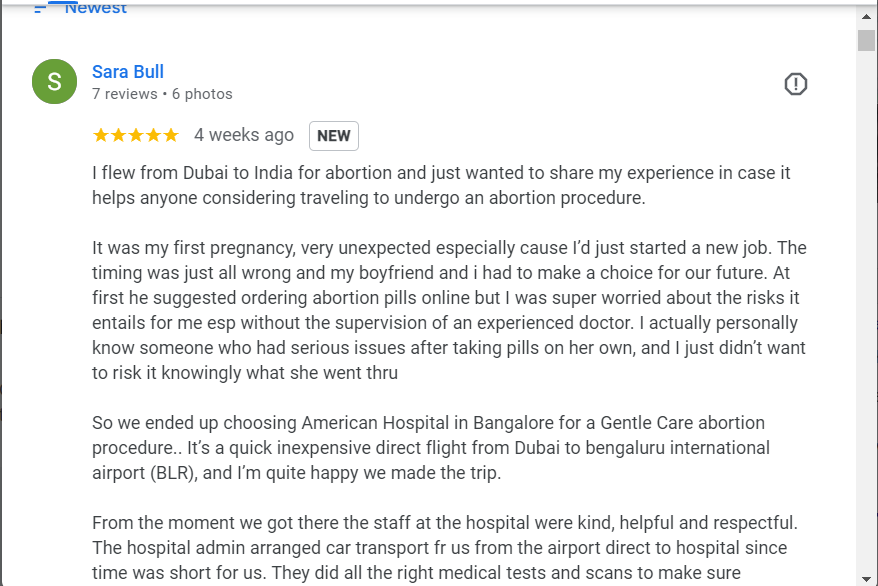
Dubai patient abortion in India
So, no matter your nationality, your religion, or your walk of life, you deserve medical care that is safe, dignified, and free from judgment. If you are facing an unplanned pregnancy, you don’t have to face it alone.
Schedule a Confidential Abortion Consultation.
Related Posts:
- The period after abortion: What to expect, how to deal with
- What to expect from period after abortion? When to Worry?
- Clearblue Pregnancy Test Results: Is the Positive Bothering You?
- Abortion Laws in India: Equal for Unmarried & Married Women
- Weekend Abortion Services for Working Women & Students
Quick Links:
- How Diagnostic Tests Can Help Cut the Cost of Abortion?
- Is it normal to feel guilty after an abortion?
- How many abortions can a woman have? Abortion Doctor Answers
- Where the Law Fails, Care Prevails: Safe Suction Abortion in India for Global Women
- Managing Self-Induced Abortion at Home: Dos and Don’ts


Leave a Comment