

How Many Weeks Pregnant Are You, Really? Common Mistakes
Common Mistakes in Calculating Pregnancy Age
Medically Reviewed by Dr Devi (MBBS, MD)
Contents of This Post:
- How do doctors count pregnancy weeks?
- Seven Pregnancy Counting Mistakes — and What to Do Instead
- What a Wrong Count Can do When you Plan an Abortion?
- The abortion pill problem: Cytotec, Unwanted Kit and other names
- Your Abortion Rights in India: What the MTP Act Says
- Meet American Hospital Bangalore: Abortion Care and Nothing Else
- Frequently Asked Questions (FAQs)
Your doctor starts counting your pregnancy about two weeks before you conceive. That quirk of medical arithmetic trips up many women who try to work out their own dates.
Meet Meera, for example. Her periods have always run irregularly, so she realises late that something has changed. A home test turns positive, and she counts eight weeks from the night she believes she conceived. Her doctor counts from the first day of her last period instead, and the ultrasound agrees: she is ten weeks pregnant. On a calendar, two weeks barely register. In a clinic, those two weeks decide which treatment she can safely choose.
If you are thinking about an abortion, the number of weeks decides three things:
- Your method. Abortion pills, suction (vacuum aspiration) and induction with Dilation and Evacuation (D&E) each suit a different stage.
- Your safety. If you take pills after their approved window, they fail more often, and a failure can mean heavy bleeding, infection or emergency surgery.
- Your legal route. India’s abortion law changes its rules at 20 weeks pregnant and again at 24.
This guide walks you through seven common counting mistakes, shows what each one can cost you and explains what India’s abortion (pregnancy termination) law allows. It also shows you how to get a number you can trust, and where to find care without judgment.
How do doctors count pregnancy weeks?
Doctors count pregnancy weeks from the first day of your last menstrual period, not from the day you conceived. Medicine calls this count gestational age.
In a textbook 28-day cycle, you ovulate around day 14, so conception happens about two weeks into the count. By the time your next period is due, doctors already call you four weeks pregnant, even though the embryo is only about two weeks old. That head start explains why a full pregnancy runs 40 weeks on paper but roughly 38 weeks from the day of conception.
| Days since your last period began | What happens in a typical 28-day cycle | Doctor’s count |
| Day 1 | Your last period starts | Week 0 |
| About day 14 | You ovulate, and conception can occur | Week 2 |
| About day 28 | Your next period is due | Week 4 |
| About day 56 | The embryo is about six weeks old | Week 8 |
Doctors then check your dates against an ultrasound. In the first trimester, a scan measures the embryo from head to rump and estimates its age to within about five to seven days. When the scan and your period dates differ by more than about a week in early pregnancy, doctors go with the scan, because it measures the pregnancy itself and does not depend on memory or a regular cycle. Scans lose precision as the weeks pass. By the second trimester, they can miss by a week or two, which is why an early scan counts most.
Seven Pregnancy Counting Mistakes — and What to Do Instead
Seven habits cause many of the dating errors women make. Knowing each one helps you spot it in your own count.
1. Counting from conception or from the night you had sex
You may know exactly when you had sex, so counting from that date feels natural. Doctors start about two weeks earlier, so your count runs roughly two weeks short. Even a known date gives only a rough date of conception, because sperm can survive inside the body for several days.
- Effect on your count: about two weeks too low.
- Do this instead: find the first day of your last period and count from there.
2. Assuming every cycle lasts 28 days
Online calculators assume you ovulate on day 14 of a 28-day cycle. Real cycles vary. In a study of more than 600,000 cycles that app users tracked, only about one in eight lasted exactly 28 days. If your cycle runs 35 days, you ovulate later, and a straight count from your last period overstates your pregnancy by about a week. If it runs 24 days, the same count understates it by about four days.
Irregular cycles stretch the error further, and they are common with PMOS, thyroid problems, heavy stress and recent childbirth. If you recently gave birth, breastfeed or just stopped hormonal contraception, you can ovulate and conceive before your first period returns, which leaves you no last period to count from.
- Effect on your count: a week or more in either direction.
- Do this instead: note your usual cycle length and tell your doctor. If your cycles are irregular, or you cannot name your last period, the doctor will use a scan to date your pregnancy.
3. Starting the clock on the wrong bleed
Light bleeding often passes for a period. Implantation spotting, bleeding around the time your period was due and breakthrough bleeding on hormonal contraception can all look like a short, light period. Up to one in four women bleed during early pregnancy. If you count from that bleed, you can lose a month, because your real last period began weeks earlier. Counting from the last day of your period instead of the first trims off the length of the period itself, usually four to seven days.
- Effect on your count: up to four weeks too low.
- Do this instead: count from the first day of your last normal period, the one that matched your usual length and flow. Tell your doctor about any lighter or oddly timed bleeding.
4. Counting in months
‘I’m two months pregnant’ can mean eight weeks or twelve. Women count months in different ways — from the last period, from the first missed period or from the day of the positive Clearblue or Preganews or any other home pregnanyc test — and a calendar month does not divide neatly into weeks. Four weeks sounds small, yet it can separate pills from suction.
- Effect on your count: up to four weeks in either direction.
- Do this instead: think in weeks and days. Count the days since your last period began and divide by seven.
5. Trusting an app, a calculator or a home test to name the week
Period apps predict from averages and know only what you log. Due-date calculators assume a regular 28-day cycle. A home pregnancy test answers one question, pregnant or not, and it cannot date the pregnancy, because hormone levels differ widely between women at the same stage. Each tool hands you a tidy number that feels certain, and none of them can see inside your womb.
- Effect on your count: unpredictable, because the tool repeats whatever you feed it.
- Do this instead: use apps and calculators for a first guess only, and check the result against a scan before you act on it.
6. Reading your body instead of the calendar
Nausea, sore breasts, tiredness, a growing belly and the first flutters of movement feel like a clock, yet they vary enormously. Some women feel sick at five weeks, and others never do. A second pregnancy often shows sooner than a first. Women first notice movement anywhere from about 16 weeks to well past 20. Fibroids, body shape and earlier pregnancies all change how a belly looks.
- Effect on your count: unreliable in both directions.
- Do this instead: treat symptoms as a sign that something has changed, not as a measure of how long ago.
7. Skipping the scan — or doubting it
A scan feels like an extra hurdle adding the cost of abortion, and some women avoid it out of fear of judgment or delay. Yet an early ultrasound dates a pregnancy more accurately than any other method, and it shows where the pregnancy sits.
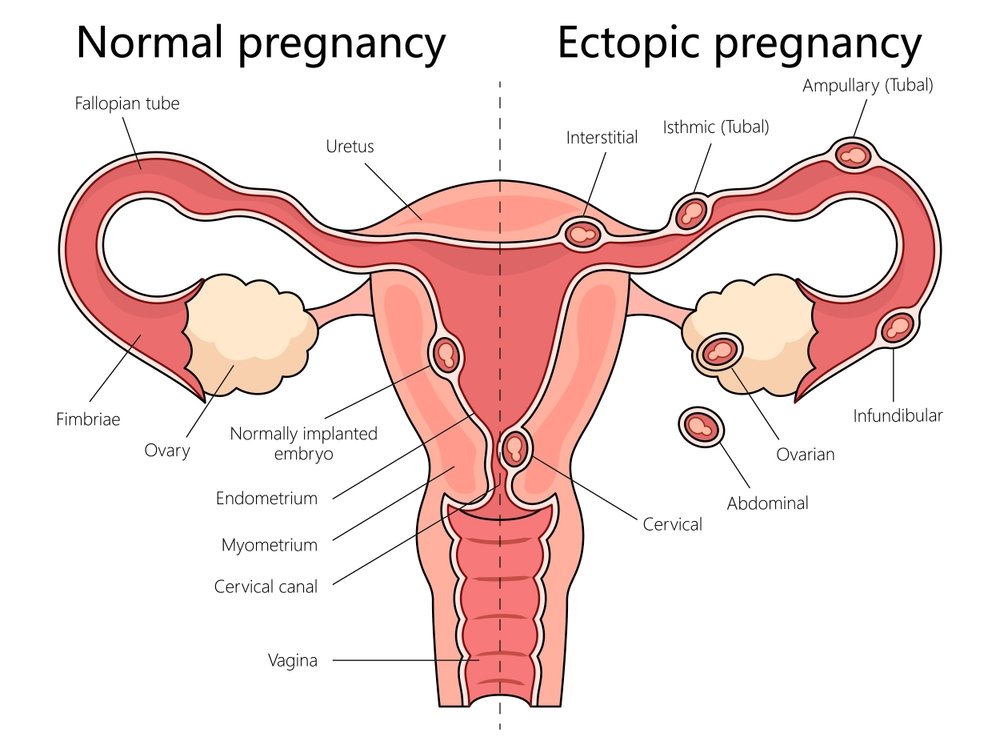
Pills do nothing for an ectopic pregnancy, one that implants outside the womb in roughly one to two of every hundred pregnancies, and an untreated ectopic pregnancy can rupture and bleed dangerously. Other women see a scan date that differs from their own count and decide the scan must be wrong. In early pregnancy, the scan usually wins.
 Effect on your count: a skipped scan leaves every other error in place and hides an ectopic pregnancy.
- Do this instead: book an ultrasound with a registered doctor before you choose a method. When the scan and your count disagree, ask which one the doctor uses and why.
What a Wrong Count Can do When you Plan an Abortion?
A miscount of just two to three weeks can move you from one method to another, or across a legal threshold. Counting from conception or from the wrong bleed always makes a pregnancy look younger than it is, and that error matters most when you choose between abortion pills and an in-clinic procedure.
The table shows how the stages usually line up in India. Your doctor makes the final call, and the stages overlap, so treat the table as a map and not a prescription.
| Weeks since your last period | Common options | What a miscount changes |
| Up to 9 weeks (63 days) | Abortion pills (mifepristone with misoprostol) under a doctor’s guidance, or suction | Pills work best here, and India’s approved window for them ends at 9 weeks |
| Up to 12 weeks | Suction abortion (vacuum aspiration) | Better & more efficient than abortion pills |
| 12 to 20 weeks | Induced abortion combined with dilatation and evacuation (D&E) | A hospital procedure replaces anything you could do at home |
| 20 to 24 weeks | The law allows termination for specified groups of women, with two doctors’ opinions | One doctor’s opinion no longer suffices |
| Beyond 24 weeks | Only on a Medical Board’s decision for substantial foetal abnormalities, or in an emergency that threatens the woman’s life | The ordinary route closes |
When the number is wrong, several problems can follow:
- Taking pills past their window. The abortion pill combination (abortion kit) works less reliably as the weeks add up. A failed or incomplete abortion can bring heavy or prolonged bleeding, infection and emergency surgery to finish the job.
- Incomplete abortion or a pregnancy that continues after a failed attempt. Misoprostol can cause birth defects when a pregnancy continues, and the label on Cytotec warns of exactly that.
- A missed ectopic pregnancy. Abortion pills do not treat it, and without a scan, nobody knows it is there.
- A plan that collapses at the clinic. You prepare for pills, learn at 11 weeks that you need a procedure and lose days arranging it.
- A false alarm. Counting too high can convince you that you have passed India’s 20-week threshold when you have not, and the panic can steer you away from safe care.
The abortion pill problem: Cytotec, Unwanted Kit and other names
Across South Asia and the Middle East, abortion pills reach women through pharmacy counters, friends and online sellers, often under names such as Cytotec and Unwanted Kit. Cytotec is a brand of misoprostol, a medicine that drug makers first developed for stomach ulcers. Unwanted Kit and other ‘MTP kits’ combine mifepristone with misoprostol. Brand names change from country to country, and from pharmacy to pharmacy, and in India both medicines are prescription drugs.
The medicines themselves are not the villain.
The World Health Organisation (WHO) lists mifepristone and misoprostol among its essential medicines, and when a doctor matches the right regimen to the right stage of pregnancy, they work well for most women. Trouble starts when guesswork replaces assessment. A strip of tablets cannot:
- Date your pregnancy. The limit on a kit’s leaflet counts from your last period, and the number you give yourself may be wrong.
- Tell you where the pregnancy sits. Only a scan rules out an ectopic pregnancy.
- Prove that the tablets are genuine. Counterfeit and poorly stored medicines circulate wherever sales go unchecked.
- Answer the phone at 2 a.m. If heavy bleeding starts, nobody who knows your history is on call.
- Confirm that the abortion is complete. Retained tissue can cause infection and ongoing bleeding.
The scale makes this a public-health issue. A 2018 study in The Lancet Global Health estimated that about three in four abortions in India in 2015 were pill abortions that women completed outside a health facility, often with tablets from a chemist. When millions of women use pills without a clinician in the room, the dates they work out for themselves decide how safe the abortion turns out to be. Worldwide, the WHO estimates that around 45% of abortions are unsafe, and that only about one in four abortions is safe in countries with the most restrictive laws.
If you have already taken pills
Do not wait it out. Get medical care urgently if you have:
- bleeding that soaks through two or more thick pads an hour for two hours in a row
- fever or chills that last more than 24 hours
- severe pain that painkillers do not ease
- foul-smelling discharge, dizziness or fainting
Tell the doctor exactly what you took, when you took it and how many weeks you think you are. If the bleeding stops but you still feel pregnant, see a doctor for a scan. Do not take another round on your own, because misoprostol can harm a pregnancy that continues.
Your Abortion Rights in India: What the MTP Act Says
India’s Medical Termination of Pregnancy (MTP) Act, as amended in 2021, sets out when and how a registered doctor can end a pregnancy legally, and it protects your consent and your privacy while the doctor does so. In plain language:
- Up to 20 weeks: one registered medical practitioner can approve and perform the termination.
- 20 to 24 weeks: two doctors must agree, and the law limits this stage to specified groups. These include survivors of sexual assault, girls under 18, women widowed or divorced during the pregnancy, women with disabilities and pregnancies with serious foetal abnormalities.
- Beyond 24 weeks: a Medical Board must find substantial foetal abnormalities, unless an emergency threatens the woman’s life.
- Your consent decides. The doctor needs your consent, not your husband’s, your partner’s or your in-laws’. Only for girls under 18 and women with a mental illness does the law require a guardian’s written consent.
- Marital status does not matter. The 2021 amendment replaced ‘husband’ with ‘partner’ in the law’s wording on contraceptive failure, and in September 2022 the Supreme Court ruled that unmarried women have the same right to safe, legal abortion as married women.
- Privacy is a legal duty. Section 5A of the Act bars doctors from revealing a woman’s name or details, except where another law requires it.
- Place matters. The Act requires the procedure to take place in a government hospital or a facility the government has approved for it, with a registered doctor in charge.
Meet American Hospital Bangalore: Abortion Care and Nothing Else
American Hospital Bangalore (AHB) is a premier abortion provider with one difference that shapes everything else: it offers abortion care and no other service.
In a general hospital, abortion patients share corridors and waiting halls with people who come for other reasons. That mix can bring unwanted opinions and curious glances, even when nobody means harm. AHB removes the mix. Every person you meet here, from your first greeting to your discharge, works in abortion care every day. Nobody wonders why you came, nobody asks you to explain yourself, and nobody passes a remark. Our team treats your decision as a medical matter and focuses on your health and comfort.
What does that look like in practice?
- Abortion care only. No other services means no other patients walk through our doors.
- One patient at a time. A team that serves only you looks after you from arrival to discharge, and you never meet another patient.
- No waiting period and no crowded waiting hall. We see you when you arrive.
- Professional and never judgmental. Our team does not comment on your reasons, your marital status or your circumstances.
- Confidential. We protect your identity and your records, as the MTP Act requires.
- Same-day discharge. You go home once your doctor confirms that the procedure is complete.
Gentle Care Abortion Services, up to 20 Weeks
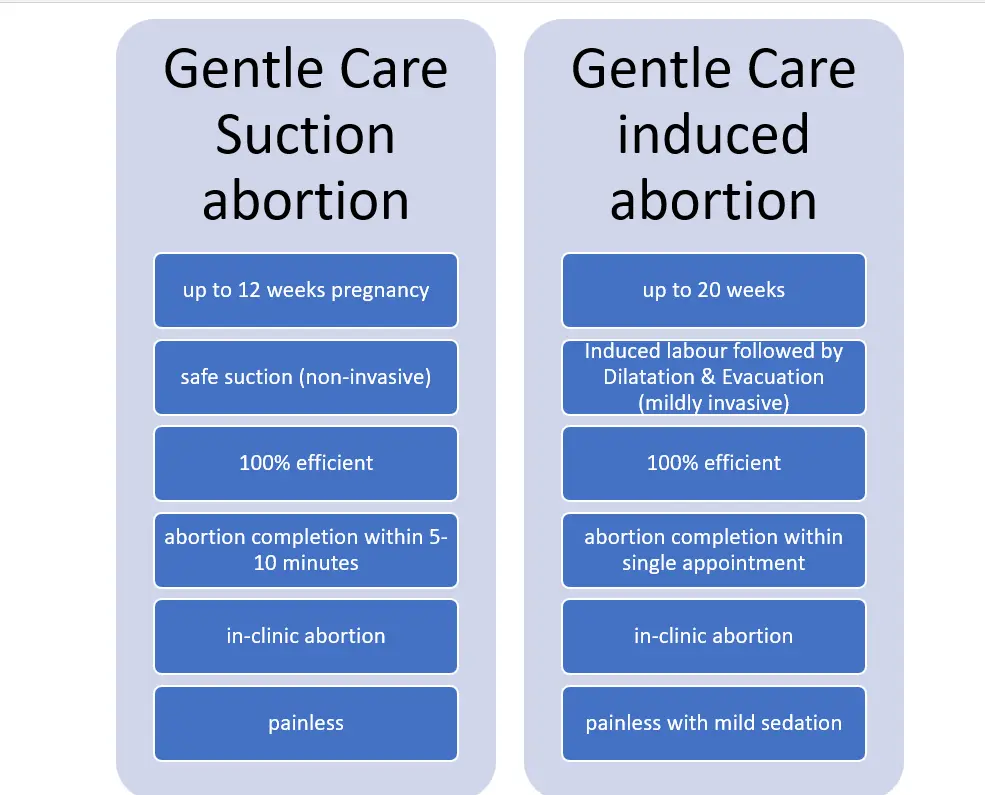
- Gentle Care Suction Abortion (up to 12 Weeks). Your doctor confirms your dates, then empties the womb with gentle suction (vacuum aspiration). The procedure itself is short, and you do not wait at home for pills to work.
- Gentle Care Induced Abortion with D&E (12 to 20 weeks). Your team begins with a gentle induction and completes the abortion with Dilation and Evacuation (D&E). Combining the two lets your doctor confirm a successful procedure before you leave our premises, so you go home with certainty instead of questions.
Gentle Care abortion in India
For Women Outside India: A Short Trip to Safe, Legal Abortion Care
If your country restricts abortion, you can travel to India for a short abortion trip, typically a day or two, and receive Gentle Care abortion services at AHB up to 20 weeks.
Across the Middle East and parts of South Asia, the law often allows abortion only in narrow circumstances. That leaves many women to carry an unwanted pregnancy or to search for pills of unknown origin. The WHO estimates that only about one in four abortions is safe in countries with the most restrictive laws, compared with nearly nine in ten in countries with the least restrictive laws.
AHB gives international patients the same legal, confidential care it gives women in India.
Before you travel:
- Check your documents. You need a valid passport and an Indian visa. Foreign patients usually apply for an e-visa, generally easily available within 24 hours online, but you should check it to avoid any problem.
- Gather your dates. Note the first day of your last period, your usual cycle length and any scan reports.
- Contact AHB before you book flights. The team can tell you what to expect and help you plan a short stay.
- Plan for a day or two. Your stay depends on how many weeks you are and which method your doctor recommends.
AHB practises under Indian law and cannot advise on the laws of other countries.
Frequently Asked Questions (FAQs)
Can I work out my pregnancy age myself?
You can estimate it. Count the days from the first day of your last period to today and divide by seven. If your cycle usually runs longer than 28 days, subtract the extra days. If it runs shorter, add the missing days. Treat the result as a rough guide, and confirm it with a scan before you decide anything.
Which number is right when my scan and my own count disagree?
In early pregnancy, doctors usually go with the scan when the two differ by more than about a week, because the scan measures the pregnancy itself.
How accurate is an ultrasound?
A first-trimester scan dates a pregnancy to within about five to seven days. Accuracy falls later in pregnancy, because babies of the same age grow at different rates.
Is abortion legal for unmarried women in India?
Yes. The 2021 amendment to the MTP Act uses the word ‘partner’ instead of ‘husband’, and in 2022 the Supreme Court ruled that unmarried women have the same right to safe, legal abortion as married women.
Will anyone find out?
The MTP Act requires doctors to keep your name and details confidential, and at AHB you meet no other patients.
How long do international patients stay?
AHB plans for a short visit, typically a day or two. The exact length depends on how many weeks you are and which abortion method your doctor recommends.
Not sure how many weeks you are? Let AHB confirm it
Whatever your number turns out to be, you have options, and you have more of them the earlier you act. A confidential consultation at American Hospital Bangalore starts with the one thing guesswork cannot give you: an accurate count.
Before you call, note down:
- the first day of your last period
- your usual cycle length
- any scan or test dates
- any medicine or pills you have taken since you found out
- any health conditions you have
Then contact American Hospital Bangalore for abortion in India. Our team answers your questions without judgment and never asks you to justify your decision.
This article offers general information, not medical or legal advice. It cannot replace an examination by a registered medical practitioner.
Related Posts:
- Dating Anxiety is Real. What If It Leads to Unplanned Pregnancy?
- Going Through Abortion Alone? Your Guide on How To Plan
- Do You Know Your Gut and Your Period Talk to Each Other?
- PMOS Doesn’t Mean You Can’t Get Pregnant — And Here’s Why That Matters
- Missed Period in Your 40s, 50s? Is it Perimenopause or Pregnancy?


Leave a Comment