
4 important things to know about surgical abortion
Last Updated: Oct 26, 2024
Contents of This Post:
- Safety of Surgical Abortion
- Risks with Surgical Abortion
- Preventing Complications with Surgical Abortion
- Up to when can you get a surgical abortion?
There are two main types of abortion procedures – medical abortion, or abortion pills, and surgical abortion. It is important that you are aware of both. This can help you prepare for whichever one your experienced medical professional suggests as per your medical condition. If you are undergoing a surgical abortion, this post is for you.
Here are 4 important things to know about the surgical abortion procedure:
#1. Surgical abortion is a safe abortion procedure.
Surgical abortion is a safe procedure when performed under the care of an MTP-certified and experienced Gynecologist at an established and reputable MTP Certified Hospital. A surgical abortion procedure performed in the first trimester is usually done with very light sedation and is minimally invasive.
However, many hospitals do not have sufficient facilities, equipment and sometimes trained professionals to perform surgical abortions. Many hospitals often prescribe Dilatation & Curettage (D&C) as a surgical abortion after 8 weeks of pregnancy. It is an invasive procedure and the patient may need anesthesia. However, most hospitals lack the advanced techniques and equipment to carry abortions with minimal invasion.
However, if you are considering an abortion in India whether as an Indian citizen or coming from any country like the UAE, Qatar, Bahrain, Philippines, Oman, Bahrain, Sri Lanka, Maldives, Malaysia, Indonesia, Singapore, Bhutan, Mauritius, Kuwait, you can obtain a safe, legal and confidential abortion with the most advanced technique available in Bangalore.
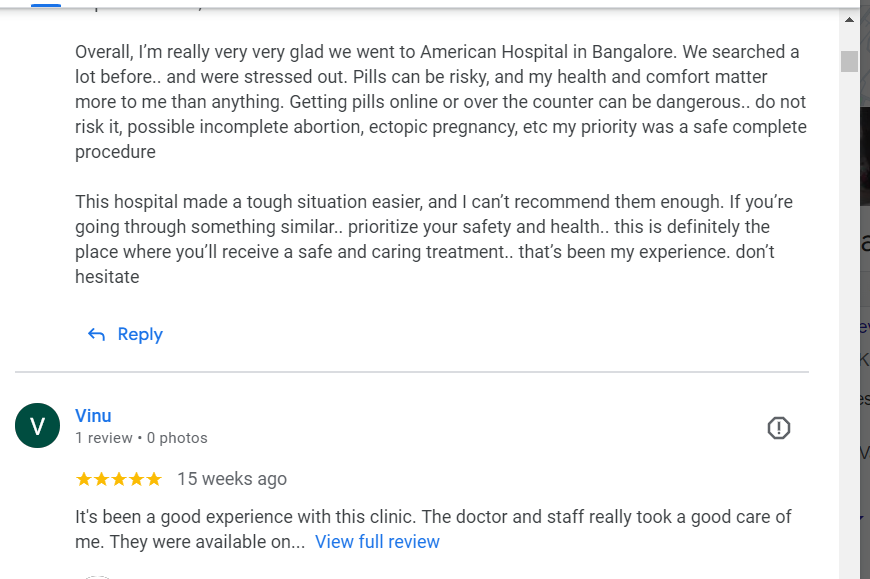
American Hospital Bangalore (AHB) offers Gentle Care suction abortion for terminating first-trimester pregnancies. They have the latest approach to removing the pregnancy tissue with almost no pain or cramps within a few minutes. It even doesn’t require anesthesia. The patient can undergo a pre-abortion consultation and then get the abortion at the same appointment.
The Gentle Care suction involves removing the pregnancy tissue using gentle suction. Firstly, the doctor inserts a soft, flexible and slender, disposable vacurette inside the cervix. She then gently sucks the tissue creating suction with an aspirator. The process takes a few minutes. You can return home the same day. Patients travelling from other cities and countries can stay overnight at a comfortable homestay in Bangalore. The next day, they can travel back knowing that they have undergone a complete abortion in just a single appointment.

#2. Risks with Surgical Abortion
There are a few risks with surgical abortion: Some of the risks may include:
- Incomplete abortion: Although very rare, with D&C, when the doctor spoons the uterus, there are chances of some pregnancy tissues remaining in the womb. These pieces can cause abdominal pain and persistent bleeding. Additionally, they can start to rot within the womb causing infection. An untreated infection can also result in sepsis, which can even be fatal.
- Damage to the cervix is uncommon but a possible complication due to internal injury.
- Adhesions, distorted uterus and internal injury can also result due to scarring to remove the pregnancy tissue.
- Infection after the abortion even with a complete abortion is possible after a surgical procedure.
Although complications exist, they are all preventable if you have your abortion procedure under the right care. Well-trained and experienced doctors perform surgical abortions very precisely while exercising caution. So, the risk of internal injury is also minimal when you visit a registered abortion hospital having highly experienced gynecologists. Additionally, the risk of incomplete abortion is uncommon at such premises.
Besides, hygienic procedures prevent complications caused by infection. When the doctors use sterile equipment and the premises are also hygienic, there are few chances of infections. So, the doctor will usually prescribe prophylactic antibiotics to prevent any infections from causing complications after the abortion.
Hygiene matters
#3. Preventing Risks with Surgical Abortion
Surgical abortion has a low complication rate if performed at an MTP (Medical Termination of Pregnancy) Certified and CAC (Comprehensive Abortion Care) procedures approved hospital. At a reputable abortion hospital, the complication rate is very low and you will have good outcomes after your procedure. CAC (Comprehensive Abortion Care) involves safe abortion procedures recommended by WHO (The World Health Organization).
Not only this, the doctors at such facilities constantly stay updated regarding advanced techniques and approaches toward patient management. Moreover, the experienced professionals perform abortions with high precision giving you the comfort of a successful procedure in a single attempt.
Besides, certified facilities follow sanitation protocols and hygiene best practices to further prevent complications, including hospital-acquired infections. So, if you have your procedure with an experienced and qualified medical professional at an MTP Certified Hospital for abortion, your risks are very low.
The effects after a surgical abortion are minimal if performed correctly. There is usually a lot less bleeding than after a medical abortion. Some of the side-effects may be some dizziness, nausea or vomiting but only for a short period after your procedure.
#4. Up to When Can You Get a Surgical Abortion?
Surgical abortion is available until later in the pregnancy than a medical abortion. Doctors do not recommend medical abortion ahead of 6-8 weeks of an intrauterine pregnancy. Whereas a surgical abortion is an open abortion option until 20 weeks because abortion in India is legal for up to 20 weeks in most cases.
Either option of abortion can be effective depending on the number of weeks of pregnancy. However, your experienced health professional can look at your unique situation and recommend the right procedure for you.
If you considering surgical abortion in India be sure to have your procedure done at a certified MTP Centre for abortion to ensure your safety and protection.
Schedule a consultation and abortion appointment.
Related Posts:
- Cost of abortion: Medical vs Surgical methods of abortion
- How is Gentle Care Abortion different from surgical abortion at any abortion clinic?
- Everything you need to know about surgical abortion in Bangalore India
- Surgical Abortion Procedure in Bangalore – Explained by Experts
- Can abortion cause infertility? Doctor Speaks Up
Quick Links:
- Join out WhatsApp community addressing common concerns
- Follow us on Facebook and be a part of our growing community sharing reproductive health concerns
- Follow us on Instagram and DM for personal queries.
- Abortion Pills Dubai: Mifepristone or Misoprostol or Both?
- Clearblue Pregnancy Test Results: Is the Positive Bothering You?


Leave a Comment